Draw condensed structures for the compounds represented by the following models (black = C, gray = H, red = O, blue = N, and green = Cl): a. <IMAGE> b. <IMAGE>
Verified step by step guidance
1
Step 1: Analyze the first molecular model (image a). Identify the atoms and their connectivity. Black spheres represent carbon (C), gray spheres represent hydrogen (H), and the green sphere represents chlorine (Cl). The structure shows a chain of three carbon atoms, with one chlorine atom attached to the third carbon.
Step 2: Determine the bonding pattern for the first model. The first carbon is bonded to three hydrogens and the second carbon. The second carbon is bonded to two hydrogens and the third carbon. The third carbon is bonded to one hydrogen and one chlorine atom.
Step 3: Write the condensed structure for the first model. Combine the bonding information into a single condensed formula, grouping hydrogens with their respective carbons. For example, CH3-CH2-CH2Cl.
Step 4: Analyze the second molecular model (image b). Identify the atoms and their connectivity. Black spheres represent carbon (C), gray spheres represent hydrogen (H), and red spheres represent oxygen (O). The structure shows a chain of four carbon atoms, with a double-bonded oxygen (C=O) on the first carbon and a single-bonded oxygen (C-O) on the second carbon.
Step 5: Write the condensed structure for the second model. Combine the bonding information into a single condensed formula, grouping hydrogens with their respective carbons and including the oxygen atoms. For example, CH3-C(O)-O-CH2-CH3.
Verified video answer for a similar problem:
This video solution was recommended by our tutors as helpful for the problem above
Video duration:
7m
Play a video:
Was this helpful?
Key Concepts
Here are the essential concepts you must grasp in order to answer the question correctly.
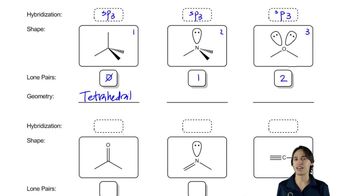
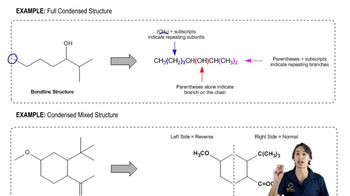
Condensed Structures
Condensed structures are simplified representations of molecular structures that show the connectivity of atoms without depicting all the bonds explicitly. In these structures, atoms are grouped together to indicate how they are bonded, often using parentheses to denote branching. This format is useful for quickly conveying the composition and arrangement of a molecule, especially in organic chemistry.
Functional groups are specific groups of atoms within molecules that are responsible for the characteristic chemical reactions of those molecules. They determine the properties and reactivity of organic compounds. Common functional groups include hydroxyl (-OH), carboxyl (-COOH), amine (-NH2), and halides (like -Cl), which can significantly influence the behavior of the compound in chemical reactions.
Molecular geometry refers to the three-dimensional arrangement of atoms in a molecule. It is determined by the number of bonds and lone pairs around a central atom, influencing the molecule's shape and reactivity. Understanding molecular geometry is crucial for predicting how molecules will interact with each other, which is essential when drawing condensed structures and analyzing chemical behavior.