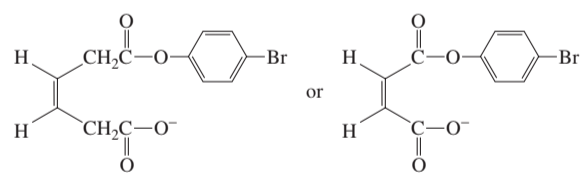
Step 1: Analyze the chemical structures of Ion A and Ion B. Ion A has two carboxylate groups adjacent to each other, while Ion B has a carboxylate group separated by a methylene (-CH2-) group from another carboxylate group.
Step 2: Recall that anhydride formation typically occurs when two carboxylic acid groups or their derivatives are close enough to interact and form a cyclic or linear anhydride. The proximity of the functional groups is crucial for the reaction to proceed rapidly.
Step 3: Consider steric and electronic factors. In Ion A, the carboxylate groups are directly adjacent, which facilitates intramolecular anhydride formation. In Ion B, the methylene group introduces a spatial separation, making the interaction between the carboxylate groups less favorable.
Step 4: Evaluate the resonance stabilization and reactivity. Ion A's structure allows for better alignment of the reactive groups, while Ion B's structure is less conducive to rapid anhydride formation due to the increased distance and reduced interaction.
Step 5: Conclude that Ion A forms an anhydride more rapidly due to the closer proximity of its carboxylate groups, which facilitates intramolecular reaction and minimizes steric hindrance.
Verified video answer for a similar problem:
This video solution was recommended by our tutors as helpful for the problem above
Video duration:
8m
Play a video:
Was this helpful?
Key Concepts
Here are the essential concepts you must grasp in order to answer the question correctly.
Anhydride Formation
Anhydrides are formed through the condensation of two carboxylic acids or a carboxylic acid and an acid chloride, resulting in the loss of water. The rate of anhydride formation can be influenced by the stability of the intermediates and the leaving groups involved in the reaction. Understanding the mechanism of this reaction is crucial for predicting which compound will form an anhydride more rapidly.
Electrophilicity refers to the tendency of a compound to attract electrons, making it more reactive in nucleophilic reactions. In the context of anhydride formation, the presence of electron-withdrawing groups can enhance the electrophilicity of the carbonyl carbon, facilitating the reaction. Analyzing the structures of Ion A and Ion B helps determine which compound has a more electrophilic carbonyl, thus influencing the rate of anhydride formation.
Resonance stabilization occurs when a molecule can be represented by multiple valid Lewis structures, distributing electron density and lowering the overall energy of the molecule. In the case of Ion A and Ion B, the presence of resonance structures can affect the stability of the intermediates formed during anhydride formation. A more stable intermediate will lead to a faster reaction rate, making resonance an important factor in determining which compound forms an anhydride more rapidly.