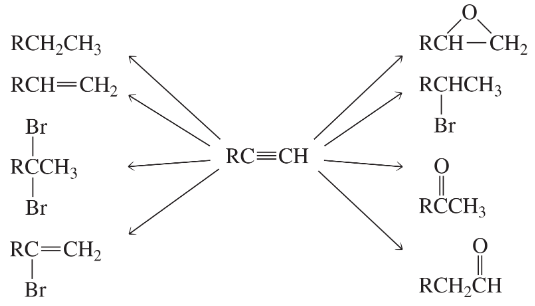
What reagents should be used to carry out the following syntheses?
Verified step by step guidance
1
Identify the starting material and the desired product for each transformation. The starting material is an alkyne (RC≡CH), and the products include alkenes, alkyl halides, and carbonyl compounds.
For the conversion of RC≡CH to RCH₂CH₃, use hydrogenation. The reagent needed is H₂ with a metal catalyst such as Pd/C or Pt.
To convert RC≡CH to RCH=CH₂, perform a partial hydrogenation. Use H₂ with a Lindlar catalyst to stop the reaction at the alkene stage.
For the transformation to RCHBrCH₃, use hydrohalogenation. The reagent required is HBr, which adds across the triple bond to form the bromoalkene.
To synthesize the carbonyl compounds, use hydration reactions. For example, to form RCOCH₃, use H₂O with a catalytic amount of H₂SO₄ and HgSO₄ to convert the alkyne to a ketone.
Verified video answer for a similar problem:
This video solution was recommended by our tutors as helpful for the problem above
Video duration:
3m
Play a video:
Was this helpful?
Key Concepts
Here are the essential concepts you must grasp in order to answer the question correctly.
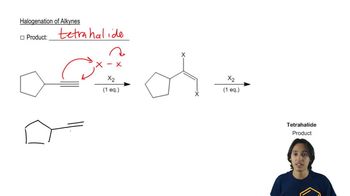
Alkyne Halogenation
Alkyne halogenation involves the addition of halogens (like Br2) to alkynes, resulting in the formation of dihaloalkenes or tetrahaloalkanes. This reaction typically proceeds through an electrophilic addition mechanism, where the triple bond of the alkyne acts as a nucleophile, attacking the halogen molecule. Understanding the regioselectivity and stereochemistry of these reactions is crucial for predicting the products.
Choosing the correct reagents is essential for successful organic synthesis. In the context of alkyne halogenation, common reagents include halogens (Br2, Cl2) and solvents like carbon tetrachloride (CCl4) or dichloromethane (CH2Cl2). The choice of reagent can influence the reaction pathway and the final product, making it important to understand their roles in the reaction mechanism.
Synthesis of Amino Acids: Strecker Synthesis Example 1
Electrophilic Addition Mechanism
The electrophilic addition mechanism is a fundamental reaction pathway in organic chemistry, particularly for unsaturated compounds like alkenes and alkynes. In this mechanism, an electrophile attacks the nucleophilic double or triple bond, leading to the formation of a more stable carbocation intermediate. This process is crucial for understanding how different reagents interact with alkynes to yield various products, as illustrated in the provided diagram.