Depending on the reaction conditions, two different imines of formula C8H9N might be formed by the reaction of benzaldehyde with methylamine. Explain, and give the structures of the two imines.
Verified step by step guidance
1
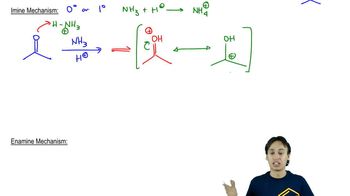
Step 1: Understand the reaction. The reaction involves benzaldehyde (C6H5CHO) reacting with methylamine (CH3NH2) to form an imine. An imine is a compound with a C=N bond, formed by the condensation of an aldehyde or ketone with a primary amine, releasing water as a byproduct.
Step 2: Identify the possible reaction sites. Benzaldehyde has a carbonyl group (C=O) at the aldehyde carbon, which is electrophilic and reacts with the nucleophilic amine group (-NH2) of methylamine. This reaction can proceed under acidic or neutral conditions.
Step 3: Consider the two possible imine structures. The first imine is formed when the aldehyde carbon reacts directly with the amine, resulting in a simple imine structure: C6H5-CH=N-CH3. This is the most straightforward product of the reaction.
Step 4: Explore the second imine structure. Under certain conditions, the reaction can lead to a tautomerization or rearrangement, where the imine nitrogen becomes part of a conjugated system with the benzene ring. This results in a structure where the imine group is conjugated with the aromatic ring, enhancing stability.
Step 5: Draw the structures of the two imines. The first imine is a simple imine: C6H5-CH=N-CH3. The second imine involves conjugation with the benzene ring, which can be represented as C6H4=N-CH3 (with the nitrogen directly bonded to the benzene ring). These two structures represent the possible products depending on the reaction conditions.
Verified video answer for a similar problem:
This video solution was recommended by our tutors as helpful for the problem above
Video duration:
4m
Play a video:
Was this helpful?
Key Concepts
Here are the essential concepts you must grasp in order to answer the question correctly.
Imines Formation
Imines are formed through the condensation reaction between an aldehyde or ketone and a primary amine. In this process, the carbonyl group of the aldehyde reacts with the amine, leading to the elimination of water and the formation of a C=N double bond. The specific conditions, such as temperature and solvent, can influence the reaction pathway and the resulting imine structure.
The stereochemistry of imines can vary based on the substituents attached to the nitrogen and the carbon involved in the double bond. Depending on the orientation of these groups, different geometric isomers (E/Z) can be formed. This stereochemical aspect is crucial when considering the reactivity and properties of the imines produced from benzaldehyde and methylamine.
The reaction conditions, including temperature, solvent, and concentration, play a significant role in determining the outcome of the imine formation. For instance, using different solvents can stabilize certain intermediates or products, leading to the preferential formation of one imine over another. Understanding how these conditions affect the reaction is essential for predicting the structures of the resulting imines.