Draw condensed and skeletal structures for each of the following amines: b. N-ethylethanamine
Verified step by step guidance
1
Step 1: Understand the name of the compound 'N-ethylethanamine'. The prefix 'N-ethyl' indicates that an ethyl group (-CH₂CH₃) is attached to the nitrogen atom. The base name 'ethanamine' refers to a two-carbon chain (ethane) with an amine group (-NH₂) attached.
Step 2: Begin by drawing the condensed structure. Start with the ethane backbone (CH₃CH₂) and attach the amine group (-NH₂) to the first carbon. Then, attach the ethyl group (-CH₂CH₃) directly to the nitrogen atom.
Step 3: Write the condensed structure using chemical notation. The condensed structure for N-ethylethanamine is CH₃CH₂NHCH₂CH₃. This notation shows the ethyl group bonded to the nitrogen and the ethanamine backbone.
Step 4: Draw the skeletal structure. In skeletal structures, carbon atoms are represented as vertices, and hydrogen atoms bonded to carbons are implied. Draw a two-carbon chain for ethanamine, with a nitrogen atom bonded to the first carbon. Then, attach another two-carbon chain (ethyl group) to the nitrogen atom.
Step 5: Verify the skeletal structure. Ensure that the nitrogen atom has three bonds (one to the ethyl group and two to the ethanamine backbone) and that all implied hydrogens are correctly accounted for. This completes the skeletal representation of N-ethylethanamine.
Verified video answer for a similar problem:
This video solution was recommended by our tutors as helpful for the problem above
Video duration:
5m
Play a video:
Was this helpful?
Key Concepts
Here are the essential concepts you must grasp in order to answer the question correctly.
Amines
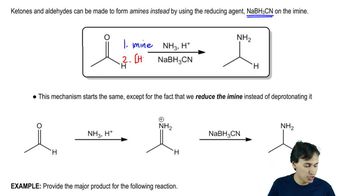
Amines are organic compounds derived from ammonia (NH3) by replacing one or more hydrogen atoms with alkyl or aryl groups. They can be classified as primary, secondary, or tertiary based on the number of carbon-containing groups attached to the nitrogen atom. Understanding the structure and classification of amines is essential for drawing their condensed and skeletal forms.
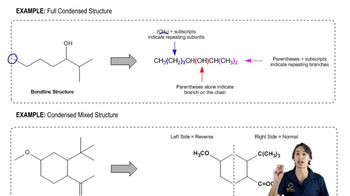
Condensed structures provide a simplified representation of a molecule, showing the connectivity of atoms without depicting all the bonds explicitly. In the case of amines, the condensed structure typically lists the carbon chains and functional groups in a linear format, which helps in visualizing the molecular composition and functional groups present in the compound.
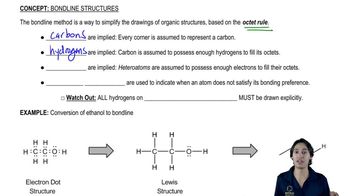
Skeletal structures, or line-angle formulas, are a shorthand way of representing organic molecules where carbon atoms are represented by vertices and hydrogen atoms are implied. This method emphasizes the connectivity of the molecule while omitting hydrogen atoms attached to carbons, making it easier to visualize larger organic compounds like amines without clutter.