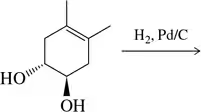
Predict the product of the following reactions. (b)
Verified step by step guidance
1
Step 1: Identify the type of reaction. The reaction involves hydrogen gas (H₂) and platinum (Pt), which indicates a catalytic hydrogenation reaction. This type of reaction typically reduces double bonds (alkenes) to single bonds (alkanes).
Step 2: Locate the functional groups in the molecule. The molecule contains a double bond (alkene), hydroxyl group (-OH), bromine atoms (Br), and an ethyl group (-CH₂CH₃). The double bond is the primary target for hydrogenation.
Step 3: Predict the effect of hydrogenation. The double bond will be reduced to a single bond, resulting in the addition of two hydrogen atoms to the carbons involved in the double bond. The stereochemistry of the product will depend on the reaction conditions, but catalytic hydrogenation typically leads to syn addition (both hydrogens added to the same face of the molecule).
Step 4: Consider the stereochemistry of the molecule. The hydroxyl group and bromine atoms are already stereochemically defined. The addition of hydrogen atoms will not affect these groups but will influence the stereochemistry of the newly formed single bond.
Step 5: Draw the product structure. Replace the double bond with a single bond and add two hydrogen atoms to the carbons that were part of the double bond. Ensure the stereochemistry is consistent with syn addition, and retain the original stereochemistry of the hydroxyl and bromine groups.
Verified video answer for a similar problem:
This video solution was recommended by our tutors as helpful for the problem above
Video duration:
4m
Play a video:
Was this helpful?
Key Concepts
Here are the essential concepts you must grasp in order to answer the question correctly.
Hydrogenation
Hydrogenation is a chemical reaction that involves the addition of hydrogen (H2) to an unsaturated compound, typically alkenes or alkynes, to convert them into saturated hydrocarbons. This process often requires a catalyst, such as platinum (Pt), palladium (Pd), or nickel (Ni), to facilitate the reaction. In the context of the provided reaction, hydrogenation will convert the alkyne into an alkene or alkane, depending on the extent of hydrogenation.
Bromination is the addition of bromine (Br2) to a compound, which can occur in various ways, including electrophilic addition to alkenes or alkynes. In the reaction shown, the presence of bromine atoms indicates that the compound has undergone bromination, which can influence the reactivity and stability of the resulting product after hydrogenation. Understanding the positioning of bromine substituents is crucial for predicting the final product.
Regioselectivity refers to the preference of a chemical reaction to yield one structural isomer over others when multiple possibilities exist. In the context of the reaction shown, the regioselectivity will determine which carbon atoms in the alkyne will be hydrogenated and how the bromine substituents will affect the final product. This concept is essential for predicting the outcome of reactions involving multiple functional groups or substituents.