δ-Hydroxyaldehydes are in equilibrium with their hemiacetal form. Predict the product that would form upon treatment of the hemiacetal with Dess–Martin periodinane.
Verified step by step guidance
1
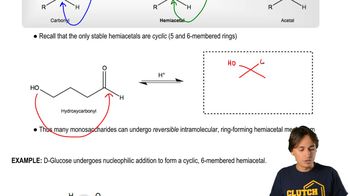
Understand the structure of δ-Hydroxyaldehydes and hemiacetals. A δ-Hydroxyaldehyde contains both an aldehyde group and a hydroxyl group, which can form a cyclic hemiacetal through intramolecular reaction.
Recognize the role of Dess–Martin periodinane (DMP) in organic reactions. DMP is a mild oxidizing agent commonly used to oxidize alcohols to carbonyl compounds.
Identify the functional groups present in the hemiacetal. The hemiacetal contains an alcohol group and an ether linkage formed from the aldehyde and hydroxyl group.
Predict the reaction outcome when the hemiacetal is treated with Dess–Martin periodinane. DMP will oxidize the alcohol group in the hemiacetal to a carbonyl group, typically forming an aldehyde or ketone.
Consider the structural changes. The oxidation of the alcohol group in the hemiacetal will lead to the formation of a new carbonyl group, resulting in a more stable cyclic structure, likely a lactone if the original δ-Hydroxyaldehyde was cyclic.
Verified video answer for a similar problem:
This video solution was recommended by our tutors as helpful for the problem above
Video duration:
3m
Play a video:
Was this helpful?
Key Concepts
Here are the essential concepts you must grasp in order to answer the question correctly.
Hemiacetal Formation
Hemiacetals are formed when an aldehyde reacts with an alcohol, resulting in a molecule with both an alcohol and an ether functional group on the same carbon. This equilibrium is crucial in understanding the behavior of δ-hydroxyaldehydes, as they can readily convert to hemiacetals under certain conditions.
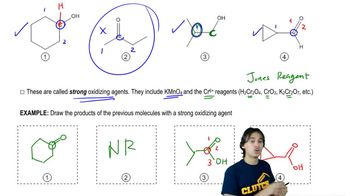
Dess–Martin periodinane is a mild oxidizing agent used in organic chemistry to selectively oxidize alcohols to aldehydes or ketones. It is particularly useful for oxidizing primary alcohols to aldehydes without over-oxidation to carboxylic acids, making it ideal for transforming hemiacetals into their corresponding aldehydes.
Oxidation of Alcohols
Oxidation of alcohols involves the conversion of an alcohol group into a carbonyl group, either an aldehyde or a ketone. In the context of hemiacetals, the alcohol portion can be oxidized to form an aldehyde, which is the expected product when treated with Dess–Martin periodinane, highlighting the transformation of functional groups in organic reactions.