
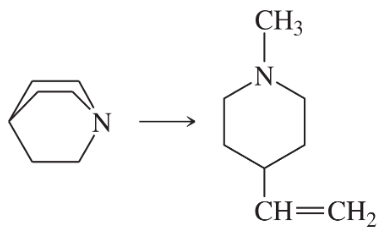
Using any necessary reagents, show how you can accomplish the following multistep syntheses. (b)
Verified step by step guidance
1
Step 1: Begin with the pyridine ring as the starting material. Perform a hydrogenation reaction using a catalyst such as palladium on carbon (Pd/C) and hydrogen gas (H₂) to reduce the aromatic ring to a saturated piperidine ring.
Step 2: Introduce a methyl group onto the nitrogen atom of the piperidine ring. This can be achieved using methyl iodide (CH₃I) in the presence of a base like potassium carbonate (K₂CO₃) to perform an alkylation reaction.
Step 3: Functionalize the piperidine ring by introducing an allyl group at the carbon adjacent to the nitrogen atom. Use allyl bromide (CH₂=CH-CH₂Br) and a base such as sodium hydride (NaH) to perform a nucleophilic substitution reaction.
Step 4: Verify the stereochemistry and ensure the allyl group is correctly positioned. If necessary, use purification techniques such as column chromatography to isolate the desired product.
Step 5: Confirm the structure of the final product using spectroscopic methods such as NMR (nuclear magnetic resonance) and IR (infrared spectroscopy) to ensure the synthesis was successful.
Verified video answer for a similar problem:
This video solution was recommended by our tutors as helpful for the problem above
Video duration:
2m
Play a video:
Was this helpful?
Key Concepts
Here are the essential concepts you must grasp in order to answer the question correctly.
Cyclic Amines
Cyclic amines are organic compounds that contain a nitrogen atom within a ring structure. They can exhibit unique reactivity due to the strain and electronic properties of the ring. Understanding the structure and properties of cyclic amines is crucial for predicting their behavior in chemical reactions, particularly in transformations such as reductions or substitutions.
Reduction reactions involve the gain of electrons or the decrease in oxidation state of a molecule. In organic chemistry, this often refers to the conversion of functional groups, such as the reduction of cyclic amines to substituted amines. Familiarity with common reducing agents, such as lithium aluminum hydride or hydrogen gas with a catalyst, is essential for performing these transformations effectively.
Alkenes are hydrocarbons that contain at least one carbon-carbon double bond. They can be formed through various reactions, including elimination reactions or dehydrogenation of saturated compounds. Understanding the mechanisms of alkene formation is important for predicting the outcomes of multistep syntheses, as they often serve as key intermediates in organic reactions.