Suggest the most appropriate reagent for each synthesis, and explain your choice. (a)
Verified step by step guidance
1
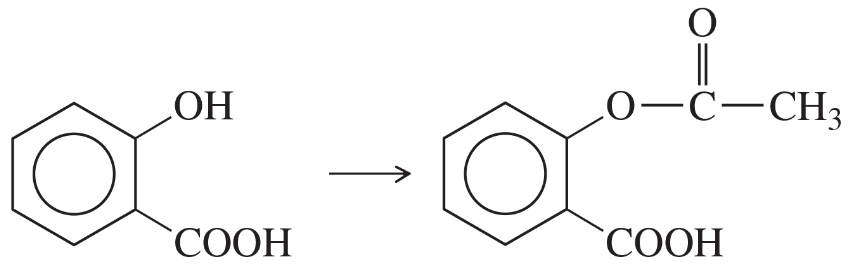
Step 1: Analyze the transformation. The starting material is salicylic acid (a benzene ring with an -OH group and a -COOH group in ortho positions). The product is acetylsalicylic acid (aspirin), where the -OH group has been converted into an ester (-OCOCH3).
Step 2: Recognize the type of reaction. This is an esterification reaction, where the hydroxyl group (-OH) reacts with an acylating agent to form an ester.
Step 3: Identify the appropriate reagent. Acetic anhydride (CH3CO)2O is commonly used for acetylation reactions because it reacts efficiently with alcohols to form esters.
Step 4: Explain the mechanism. In the presence of a catalyst like sulfuric acid or phosphoric acid, acetic anhydride reacts with the hydroxyl group of salicylic acid. The acyl group (CH3CO-) is transferred to the -OH group, forming the ester bond.
Step 5: Note reaction conditions. The reaction typically requires mild heating to ensure the acetylation proceeds efficiently, and the catalyst helps to speed up the reaction by protonating the acetic anhydride, making it more reactive.
Verified video answer for a similar problem:
This video solution was recommended by our tutors as helpful for the problem above
Video duration:
6m
Play a video:
Was this helpful?
Key Concepts
Here are the essential concepts you must grasp in order to answer the question correctly.
Reagent Selection in Organic Synthesis
Choosing the right reagent is crucial in organic synthesis as it determines the efficiency and outcome of the reaction. Factors such as the desired product, reaction conditions, and the functional groups present in the reactants must be considered. Understanding the reactivity and selectivity of different reagents helps in predicting the formation of the desired product.
Synthesis of Amino Acids: Strecker Synthesis Example 1
Functional Groups
Functional groups are specific groups of atoms within molecules that are responsible for the characteristic chemical reactions of those molecules. Identifying the functional groups in the reactants and products is essential for selecting appropriate reagents, as different functional groups react differently under various conditions. This knowledge aids in predicting the pathways and mechanisms of the synthesis.
A reaction mechanism describes the step-by-step process by which reactants are converted into products. Understanding mechanisms is vital for predicting the outcomes of reactions and for rationalizing the choice of reagents. Knowledge of mechanisms also helps in identifying potential side reactions and optimizing conditions for the desired synthesis.