Predict which member of each pair is more acidic, and explain the reasons for your predictions. a. cyclopentanol or 3-chlorophenol
Verified step by step guidance
1
Step 1: Recall the general principle of acidity. Acidity is influenced by the stability of the conjugate base formed after the proton (H⁺) is lost. A more stable conjugate base corresponds to a stronger acid.
Step 2: Analyze the structure of cyclopentanol. Cyclopentanol is a cyclic alcohol with no electron-withdrawing groups. When it loses a proton, the resulting conjugate base (cyclopentoxide ion) is stabilized only by the negative charge on the oxygen atom, with no additional stabilization from resonance or inductive effects.
Step 3: Analyze the structure of 3-chlorophenol. 3-Chlorophenol is a phenol derivative with a chlorine atom attached to the benzene ring at the meta position. When it loses a proton, the resulting conjugate base (3-chlorophenoxide ion) is stabilized by resonance delocalization of the negative charge across the aromatic ring. Additionally, the chlorine atom exerts an inductive electron-withdrawing effect, further stabilizing the conjugate base.
Step 4: Compare the conjugate bases. The conjugate base of 3-chlorophenol is more stabilized due to resonance and the inductive effect of the chlorine atom, whereas the conjugate base of cyclopentanol lacks these stabilizing factors.
Step 5: Conclude that 3-chlorophenol is more acidic than cyclopentanol because its conjugate base is more stable due to resonance and inductive effects.
Verified video answer for a similar problem:
This video solution was recommended by our tutors as helpful for the problem above
Video duration:
7m
Play a video:
Was this helpful?
Key Concepts
Here are the essential concepts you must grasp in order to answer the question correctly.
Acidity and pKa
Acidity in organic chemistry refers to the tendency of a compound to donate a proton (H+). The strength of an acid is often measured by its pKa value; lower pKa values indicate stronger acids. Understanding the relationship between structure and acidity is crucial, as factors like electronegativity and resonance can significantly influence a compound's ability to stabilize the negative charge of its conjugate base.
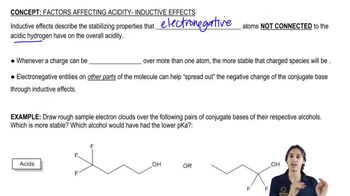
The inductive effect describes how the presence of electronegative atoms or groups can influence the acidity of a compound by stabilizing the negative charge on the conjugate base. In the case of 3-chlorophenol, the chlorine atom exerts a -I (negative inductive) effect, which helps to stabilize the phenoxide ion formed after deprotonation, making it more acidic compared to cyclopentanol.
Resonance stabilization occurs when a conjugate base can delocalize its negative charge over multiple atoms, enhancing its stability. In 3-chlorophenol, the phenoxide ion can distribute the negative charge across the aromatic ring, further stabilizing it. This resonance effect contributes to the increased acidity of 3-chlorophenol compared to cyclopentanol, which lacks such stabilization.