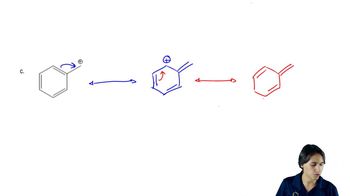
Draw the important resonance forms of the following cations and anions: (c) (d)
Verified step by step guidance
1
Identify the atoms that can participate in resonance. In the cation [H2C=CHCNH2(=OH)]+, the positive charge is on the carbon atom bonded to the NH2 group and the OH group. In the anion [H3CCHC(=O)CH=CHCN]-, the negative charge is on the carbon atom adjacent to the carbonyl group.
For the cation, consider the movement of electrons from the lone pair on the nitrogen atom to form a double bond with the adjacent carbon, which can delocalize the positive charge. This will result in a resonance structure where the positive charge is now on the oxygen atom.
For the anion, consider the movement of the pi electrons from the carbon-carbon double bond towards the carbonyl group. This can result in a resonance structure where the negative charge is delocalized onto the oxygen atom of the carbonyl group.
Draw the resonance structures for the cation: one with the positive charge on the carbon atom and another with the positive charge on the oxygen atom after the lone pair on nitrogen forms a double bond.
Draw the resonance structures for the anion: one with the negative charge on the carbon atom and another with the negative charge on the oxygen atom after the pi electrons move towards the carbonyl group.
Verified video answer for a similar problem:
This video solution was recommended by our tutors as helpful for the problem above
Video duration:
7m
Play a video:
0 Comments
Key Concepts
Here are the essential concepts you must grasp in order to answer the question correctly.
Resonance Structures
Resonance structures are different ways of drawing the same molecule that illustrate the delocalization of electrons. They help in understanding the stability and reactivity of a molecule by showing how electrons can be distributed across different atoms. In organic chemistry, resonance is crucial for predicting the behavior of cations and anions, as it can stabilize charges through electron sharing.
Cations (positively charged species) and anions (negatively charged species) exhibit different stabilities based on their electronic environments. Cations are generally stabilized by electron-donating groups, while anions are stabilized by electron-withdrawing groups. Understanding the factors that influence the stability of these charged species is essential for predicting their reactivity and the formation of resonance structures.
Electron delocalization refers to the spreading of electron density across multiple atoms in a molecule, which can lower the overall energy and increase stability. This phenomenon is particularly important in resonance structures, where electrons are not confined to a single bond or atom. Recognizing how delocalization occurs helps in drawing accurate resonance forms and understanding the properties of organic compounds.