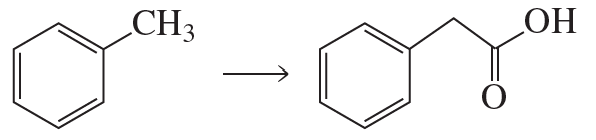
Show how the following compounds could be prepared from the given starting materials. You can use any necessary organic or inorganic reagents. d.
Verified step by step guidance
1
Step 1: Analyze the starting material and the target compound. The starting material is styrene (C6H5-CH=CH2), and the target compound is phenylbutanoic acid (C6H5-CH2-CH2-COOH). The transformation involves adding two carbons and converting the alkene into a carboxylic acid.
Step 2: Perform a hydroboration-oxidation reaction on the styrene. Use BH3 (borane) followed by H2O2 (hydrogen peroxide) and NaOH (sodium hydroxide) to convert the alkene into a primary alcohol (C6H5-CH2-CH2-OH). This reaction adds water across the double bond in an anti-Markovnikov fashion.
Step 3: Oxidize the primary alcohol to a carboxylic acid. Use a strong oxidizing agent such as KMnO4 (potassium permanganate) or CrO3 (chromium trioxide) in acidic conditions to convert the alcohol group (-CH2OH) into a carboxylic acid (-COOH).
Step 4: Verify the structure of the product. Ensure that the phenyl group (C6H5-) remains intact and the two-carbon chain is correctly added, leading to the formation of phenylbutanoic acid.
Step 5: Review the reaction conditions and reagents used to ensure compatibility with the functional groups present in the starting material and the target compound.
Verified video answer for a similar problem:
This video solution was recommended by our tutors as helpful for the problem above
Video duration:
2m
Play a video:
Was this helpful?
Key Concepts
Here are the essential concepts you must grasp in order to answer the question correctly.
Ester Hydrolysis
Ester hydrolysis is a chemical reaction where an ester reacts with water in the presence of an acid or base to form an alcohol and a carboxylic acid. In acid-catalyzed hydrolysis, the ester is protonated, making it more susceptible to nucleophilic attack by water, leading to the cleavage of the ester bond. This reaction is important in organic synthesis and can be used to convert esters back to their corresponding carboxylic acids and alcohols.
In organic synthesis, various reagents are employed to facilitate chemical reactions. Common reagents include acids, bases, oxidizing agents, and reducing agents, each serving specific roles in transforming reactants into desired products. Understanding the function and mechanism of these reagents is crucial for predicting the outcome of reactions and designing synthetic pathways.
Synthesis of Amino Acids: Strecker Synthesis Example 1
Mechanism of Acid-Catalyzed Reactions
The mechanism of acid-catalyzed reactions involves the donation of a proton (H+) from the acid to the reactant, enhancing its electrophilicity. This step often leads to the formation of a more reactive intermediate, which can then undergo further reactions, such as nucleophilic attack. Familiarity with these mechanisms allows chemists to manipulate reaction conditions to favor the formation of specific products.