
Determine the number of elements of unsaturation in the molecular formula C4H6. Give all nine possible structures having this formula. Remember that a double bond = one element of unsaturation a ring = one element of unsaturation a triple bond = two elements of unsaturation
Verified step by step guidance
1
Step 1: Calculate the degree of unsaturation using the formula: Degree of Unsaturation = (2C + 2 + N - H) / 2, where C is the number of carbons, N is the number of nitrogens, and H is the number of hydrogens.
Step 2: Substitute the values from the molecular formula C4H9N into the formula: Degree of Unsaturation = (2(4) + 2 + 1 - 9) / 2.
Step 3: Simplify the expression to find the degree of unsaturation. This will tell you how many rings and/or multiple bonds are present in the molecule.
Step 4: Use the degree of unsaturation to determine possible structures. Consider combinations of rings, double bonds, and triple bonds that match the degree of unsaturation.
Step 5: Draw all possible structures that fit the molecular formula C4H9N and the calculated degree of unsaturation. Ensure that each structure adheres to the rules of valency for carbon and nitrogen.
Verified video answer for a similar problem:
This video solution was recommended by our tutors as helpful for the problem above
Play a video:
Was this helpful?
Key Concepts
Here are the essential concepts you must grasp in order to answer the question correctly.
Elements of Unsaturation
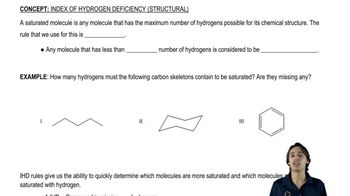
Elements of unsaturation, also known as degrees of unsaturation, indicate the number of rings and multiple bonds (double or triple) in a molecule. Each double bond or ring counts as one element of unsaturation, while a triple bond counts as two. This concept helps in determining the possible structures of a molecule from its molecular formula.
The difference between saturated and unsaturated molecules.
Molecular Formula Analysis
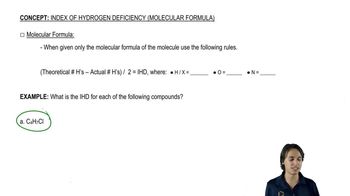
Analyzing a molecular formula involves calculating the elements of unsaturation to predict possible structures. For a given formula, the degrees of unsaturation can be calculated using the formula: (2C + 2 + N - H)/2, where C, N, and H are the number of carbon, nitrogen, and hydrogen atoms, respectively. This calculation helps in identifying the presence of rings or multiple bonds.
Structural isomerism occurs when molecules with the same molecular formula have different connectivity of atoms. In the context of C4H9N, structural isomers can include variations in the arrangement of carbon chains, the position of nitrogen, and the presence of rings or multiple bonds. Understanding isomerism is crucial for enumerating all possible structures for a given formula.