Show how you would synthesize the following derivatives from appropriate carbonyl compounds. (d)
Verified step by step guidance
1
Step 1: Identify the target molecule. The structure contains a benzene ring fused to a cyclohexane ring (tetralin structure) with a side chain containing an ether functional group (a methoxy group attached to a cyclopropane). This suggests the need for a carbonyl precursor and subsequent functional group transformations.
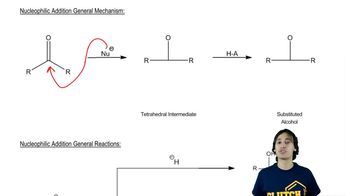
Step 2: Choose an appropriate carbonyl compound as the starting material. A ketone such as 1-tetralone (a ketone on the tetralin structure) can serve as the precursor for the synthesis. This is because ketones are versatile intermediates for introducing side chains via nucleophilic addition reactions.
Step 3: Perform a nucleophilic addition reaction to introduce the side chain. React the ketone with a Grignard reagent or organolithium reagent containing the desired side chain structure (e.g., a cyclopropylmethyl group). This step will form a tertiary alcohol intermediate.
Step 4: Convert the tertiary alcohol into the ether functional group. Use a methylating agent such as methyl iodide (CH3I) in the presence of a base (e.g., NaH or K2CO3) to replace the hydroxyl group with a methoxy group, forming the ether.
Step 5: Verify the stereochemistry and ensure the final product matches the target molecule. If necessary, use purification techniques such as recrystallization or chromatography to isolate the desired derivative.
Verified video answer for a similar problem:
This video solution was recommended by our tutors as helpful for the problem above
Video duration:
2m
Play a video:
Was this helpful?
Key Concepts
Here are the essential concepts you must grasp in order to answer the question correctly.
Carbonyl Compounds
Carbonyl compounds are organic molecules that contain a carbon atom double-bonded to an oxygen atom (C=O). They are fundamental in organic chemistry and include aldehydes, ketones, carboxylic acids, and esters. Understanding their structure and reactivity is crucial for synthesizing derivatives, as they serve as key intermediates in various reactions.
Nucleophilic addition reactions involve the attack of a nucleophile on the electrophilic carbon of a carbonyl group. This reaction is a cornerstone in organic synthesis, allowing for the formation of alcohols, amines, and other functional groups. Mastery of this concept is essential for designing synthetic pathways to create desired derivatives from carbonyl compounds.
Functional group transformations refer to the chemical reactions that convert one functional group into another. In the context of synthesizing derivatives from carbonyl compounds, this concept encompasses various reactions such as reduction, oxidation, and substitution. Understanding these transformations is vital for manipulating carbonyl compounds to achieve specific target molecules.