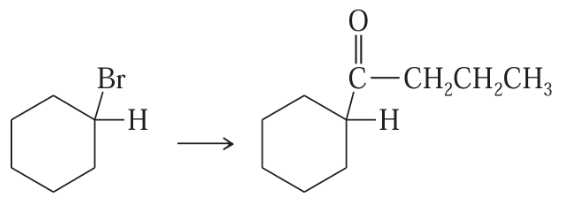
Show how you would accomplish the following synthetic conversions. (c)
Verified step by step guidance
1
Step 1: Analyze the starting material and product. The starting material is cyclohexyl bromide, and the product is cyclohexyl propanone. This indicates that the bromine atom needs to be replaced with a propanone group.
Step 2: Perform a nucleophilic substitution reaction. Use a nucleophile such as cyanide ion (CN⁻) to replace the bromine atom with a cyano group (-CN). This reaction is typically carried out using sodium cyanide (NaCN) in a polar aprotic solvent like DMSO.
Step 3: Hydrolyze the cyano group to a carboxylic acid. Treat the intermediate cyclohexyl cyanide with acidic or basic hydrolysis conditions (e.g., H₃O⁺ or NaOH followed by acid workup) to convert the -CN group into a carboxylic acid (-COOH).
Step 4: Perform a decarboxylation reaction. React the carboxylic acid with propyl magnesium bromide (C₃H₇MgBr), a Grignard reagent, to form the ketone group. This step involves nucleophilic addition of the Grignard reagent to the carboxylic acid, followed by elimination of water.
Step 5: Purify the product. After the reaction is complete, isolate and purify cyclohexyl propanone using techniques such as distillation or recrystallization.
Verified video answer for a similar problem:
This video solution was recommended by our tutors as helpful for the problem above
Video duration:
8m
Play a video:
Was this helpful?
Key Concepts
Here are the essential concepts you must grasp in order to answer the question correctly.
Nucleophilic Substitution
Nucleophilic substitution is a fundamental reaction in organic chemistry where a nucleophile attacks an electrophilic carbon atom, replacing a leaving group. In this case, the bromine atom (Br) on the cyclohexane ring acts as a leaving group, allowing a nucleophile to take its place. Understanding this mechanism is crucial for predicting the products of the reaction.
Nucleophiles and Electrophiles can react in Substitution Reactions.
Electrophilic Addition
Electrophilic addition involves the reaction of an electrophile with a nucleophile, leading to the formation of a more complex molecule. In the context of the provided reaction, the carbonyl group (C=O) can act as an electrophile, facilitating the addition of a nucleophile to form a new carbon-carbon bond. This concept is essential for understanding how the structure of the product is formed from the starting materials.
Functional group transformation refers to the process of converting one functional group into another through chemical reactions. In this case, the transformation involves converting a bromine substituent into a carbonyl group, which is a key step in synthesizing the desired product. Recognizing and manipulating functional groups is vital for successful organic synthesis.