Which of the following are correct? Correct any false statements c. A conjugated diene with an odd number of double bonds has a symmetric HOMO.
Verified step by step guidance
1
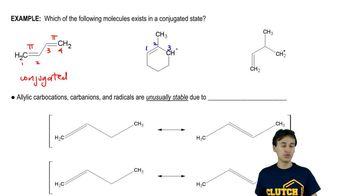
Step 1: Understand the concept of conjugated dienes. A conjugated diene is a molecule with two double bonds separated by a single bond, allowing for delocalization of π-electrons across the system. This delocalization affects the molecular orbitals, including the Highest Occupied Molecular Orbital (HOMO).
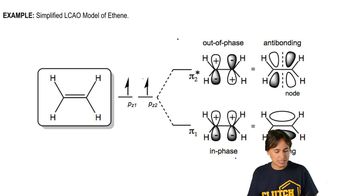
Step 2: Recall the molecular orbital theory for conjugated systems. The number of molecular orbitals corresponds to the number of atomic p orbitals involved in the conjugation. These orbitals are arranged in increasing energy levels, with alternating symmetric and antisymmetric wavefunctions.
Step 3: Analyze the symmetry of the HOMO. For a conjugated diene with an odd number of double bonds, the total number of π-electrons is also odd. The HOMO will be the highest energy orbital that is fully occupied. Symmetry of the HOMO depends on the number of nodes (regions where the wavefunction changes sign) in the orbital.
Step 4: Determine the symmetry of the HOMO for odd-numbered conjugated systems. In such systems, the HOMO is typically antisymmetric, not symmetric, because the wavefunction alternates in sign across the conjugated system. This contradicts the statement in the problem.
Step 5: Correct the false statement. The corrected statement should read: 'A conjugated diene with an odd number of double bonds has an antisymmetric HOMO.'
Verified video answer for a similar problem:
This video solution was recommended by our tutors as helpful for the problem above
Video duration:
8m
Play a video:
Was this helpful?
Key Concepts
Here are the essential concepts you must grasp in order to answer the question correctly.
Conjugated Dienes
Conjugated dienes are organic compounds that contain two double bonds separated by a single bond. This arrangement allows for the delocalization of π electrons across the entire system, which can enhance stability and reactivity. Understanding the structure and behavior of conjugated dienes is crucial for predicting their chemical properties and reactions.
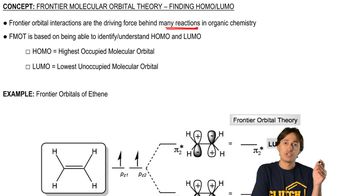
HOMO (Highest Occupied Molecular Orbital) and LUMO (Lowest Unoccupied Molecular Orbital) are key concepts in molecular orbital theory. The HOMO is the highest energy orbital that contains electrons, while the LUMO is the lowest energy orbital that is empty. The symmetry and energy of these orbitals play a significant role in determining the reactivity of molecules, particularly in reactions involving electron transfer.
Symmetry in molecular orbitals refers to the spatial arrangement and behavior of electrons within those orbitals. A symmetric HOMO implies that the electron density is evenly distributed, which can influence the molecule's reactivity and interaction with other species. In the case of conjugated dienes, the symmetry of the HOMO can vary depending on the number of double bonds, affecting the overall electronic properties of the molecule.