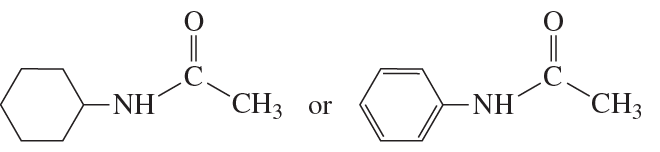
Which compound has the greater electron density on its oxygen atom?
Verified step by step guidance
1
Identify the compounds involved in the problem. If the compounds are not explicitly provided, consider the context or ask for clarification to proceed.
Examine the structure of each compound, focusing on the oxygen atom. Look for factors that influence electron density, such as resonance, inductive effects, and electronegativity of nearby atoms.
Analyze the resonance structures of each compound. Determine if the oxygen atom participates in resonance and whether this increases or decreases its electron density.
Evaluate the inductive effects caused by nearby atoms or groups. Electronegative atoms or electron-withdrawing groups near the oxygen atom will reduce its electron density, while electron-donating groups will increase it.
Compare the findings for each compound. The compound with the oxygen atom having the least electron-withdrawing effects and the most electron-donating effects will have the greater electron density on its oxygen atom.
Verified video answer for a similar problem:
This video solution was recommended by our tutors as helpful for the problem above
Video duration:
10m
Play a video:
Was this helpful?
Key Concepts
Here are the essential concepts you must grasp in order to answer the question correctly.
Electronegativity
Electronegativity is a measure of an atom's ability to attract and hold onto electrons. In organic chemistry, oxygen is highly electronegative, meaning it pulls electron density towards itself when bonded to other atoms. This property influences the distribution of electron density in molecules, affecting their reactivity and interactions.
Resonance structures are different ways of drawing a molecule that represent the same compound, showing the delocalization of electrons. In compounds with resonance, the electron density can be spread over multiple atoms, including oxygen. Understanding resonance helps predict where electron density is concentrated, which is crucial for determining the reactivity of the compound.
The inductive effect refers to the transmission of charge through a chain of atoms in a molecule due to the electronegativity of nearby atoms. Electron-withdrawing groups can decrease electron density on an oxygen atom, while electron-donating groups can increase it. This effect is important for analyzing how substituents influence the electron density on functional groups like alcohols or ethers.