Textbook Question
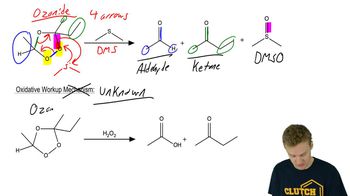
Thiols are prone to dimerize through the formation of a disulfide bond in a reaction that stylists use to induce permanent curls in hair. What type of reagent would you use to effect this transformation?
1035
views

 Mullins 1st EditionCh. 13 - Alcohols, Ethers and Related Compounds: Substitution and EliminationProblem 111
 Verified step by step guidance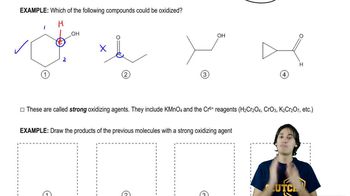
 03:40
03:40
 01:31
01:31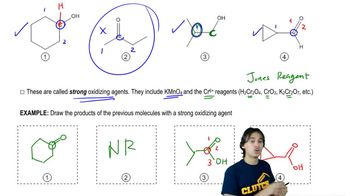 05:53
05:53Thiols are prone to dimerize through the formation of a disulfide bond in a reaction that stylists use to induce permanent curls in hair. What type of reagent would you use to effect this transformation?
Triphenylphosphine and iodine can be used to convert alcohols to iodoalkanes. Suggest a mechanism for this reaction. [Triphenylphosphine first acts as a nucleophile in this reaction.]
Cleavage of the following ether produces the alcohol and haloalkane only, regardless of how much HBr is used. Thinking about the mechanism of the reaction, explain why bromobenzene is not also a product of this reaction.
A chemist attempted the reaction below, one we introduce in Chapter 17, expecting the reaction between a strong nucleophile and a ketone in water to give an alkoxide product.
(a) Why did the reaction fail?
(b) How could the reaction conditions be changed to give a successful reaction?
In Chapter 12, we learned that crown ethers were used to increase the rate of SN2 reactions (Assessment 12.80). Suggest a synthesis of 15-crown-5 using the reactions learned here in Chapter 13.
Another method for converting alcohols to chloroalkanes makes use of chlorotrimethylsilane (TMSCl) and DMSO. Suggest a mechanism for this reaction to form (a) a 1° chloroalkane and (b) a 3° chloroalkane. [The reaction begins by the reaction of DMSO and TMSCl and is analogous to the Swern oxidation.]