Practice your electron-pushing skills by drawing a mechanism for the following E1 reactions. (c)
Verified step by step guidance
1
Step 1: Identify the reaction type. This is an E1 elimination reaction, which involves two steps: the formation of a carbocation intermediate and the elimination of a proton to form a double bond.
Step 2: Analyze the substrate. The starting molecule contains a tertiary alkyl chloride group. Tertiary carbocations are highly stable due to hyperconjugation and inductive effects, making this substrate suitable for an E1 mechanism.
Step 3: First step of the mechanism - Formation of the carbocation. The chlorine atom (Cl) leaves as a chloride ion (Cl⁻), resulting in the formation of a tertiary carbocation at the bridgehead position. This step is facilitated by the polar protic solvent (H₂O), which stabilizes the carbocation.
Step 4: Second step of the mechanism - Proton elimination. A hydrogen atom from a β-carbon (adjacent to the carbocation) is removed by water acting as a base. The electrons from the C-H bond move to form a π bond, resulting in the formation of the double bond in the product.
Step 5: Verify the product structure. The final product is a bicyclic alkene with a double bond in the ring system, as shown in the image. Ensure the double bond is correctly positioned based on the most stable carbocation and elimination pathway.
Verified video answer for a similar problem:
This video solution was recommended by our tutors as helpful for the problem above
Play a video:
Was this helpful?
Key Concepts
Here are the essential concepts you must grasp in order to answer the question correctly.
E1 Reaction Mechanism
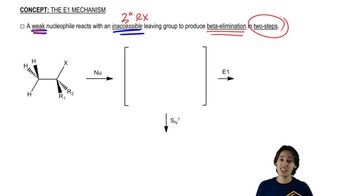
The E1 (unimolecular elimination) reaction is a two-step mechanism where the first step involves the formation of a carbocation intermediate after the leaving group departs. This is followed by the deprotonation of a neighboring carbon to form a double bond. Understanding this mechanism is crucial for predicting the products and the stability of intermediates involved.
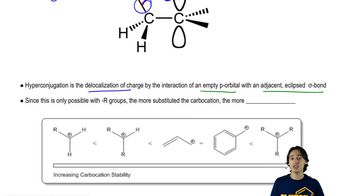
Carbocation stability is a key factor in E1 reactions, as more stable carbocations will form more readily. Stability is influenced by factors such as the degree of substitution (tertiary > secondary > primary) and resonance effects. Recognizing the stability of potential carbocation intermediates helps in determining the feasibility and rate of the E1 reaction.
Electron-pushing curved arrows are a notation used to illustrate the movement of electron pairs during chemical reactions. In the context of E1 mechanisms, these arrows help depict the departure of the leaving group and the subsequent formation of the double bond. Mastery of this notation is essential for accurately representing reaction mechanisms and understanding the flow of electrons.