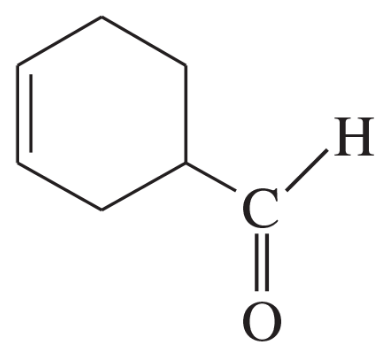
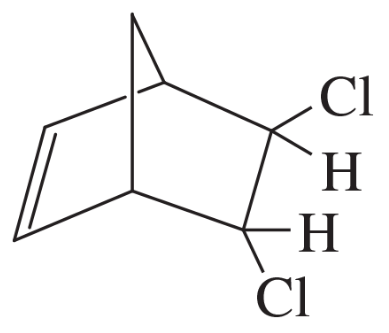
Show how Diels–Alder reactions might be used to synthesize the following compounds. (a) (b)
Verified step by step guidance
1
Step 1: Understand the Diels–Alder reaction mechanism. It is a [4+2] cycloaddition reaction between a conjugated diene and a dienophile, forming a six-membered ring. The reaction is stereospecific and regioselective, meaning the substituents on the diene and dienophile influence the stereochemistry and regiochemistry of the product.
Step 2: For compound (a), identify the diene and dienophile required to form the bicyclic structure. The bicyclic system suggests the use of a cyclic diene, such as cyclopentadiene, and a dienophile with bromine substituents. The bromine atoms on the dienophile will dictate the stereochemistry of the final product.
Step 3: For compound (b), identify the diene and dienophile required to form the six-membered ring with a cyano group. The cyano group suggests the dienophile should contain a nitrile (-CN) functional group. The diene could be a simple conjugated diene, such as 1,3-butadiene.
Step 4: Predict the stereochemistry and regiochemistry of the products. For compound (a), the bromine substituents on the dienophile will determine the stereochemistry of the bicyclic product. For compound (b), the cyano group will direct the regiochemistry of the addition, ensuring the nitrile group is positioned correctly on the six-membered ring.
Step 5: Draw the reaction schemes for both compounds. For (a), show the reaction between cyclopentadiene and a bromine-substituted dienophile. For (b), show the reaction between 1,3-butadiene and a nitrile-substituted dienophile. Ensure the stereochemistry and regiochemistry are consistent with the final products.
Verified video answer for a similar problem:
This video solution was recommended by our tutors as helpful for the problem above
Video duration:
4m
Play a video:
Was this helpful?
Key Concepts
Here are the essential concepts you must grasp in order to answer the question correctly.
Diels–Alder Reaction
The Diels–Alder reaction is a [4+2] cycloaddition reaction between a conjugated diene and a dienophile, resulting in the formation of a six-membered ring. This reaction is a powerful tool in organic synthesis due to its ability to create complex cyclic structures with high stereoselectivity and regioselectivity. Understanding the mechanism, which involves the formation of a cyclic transition state, is crucial for predicting the products formed in the reaction.
Conjugated dienes are compounds that contain two double bonds separated by a single bond, allowing for delocalization of π electrons. This delocalization enhances the stability of the diene and makes it more reactive in Diels–Alder reactions. Recognizing the structure and reactivity of conjugated dienes is essential for designing synthetic pathways using this reaction.
Stereochemistry plays a significant role in Diels–Alder reactions, as the orientation of substituents on the diene and dienophile affects the stereochemical outcome of the product. The reaction can lead to the formation of stereoisomers, including cis and trans configurations, depending on the substituents' positions. Understanding how to predict and analyze these stereochemical outcomes is vital for synthesizing specific compounds.