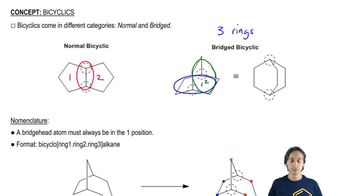
Each of the following descriptions applies to more than one alkane. In each case, draw and name two structures that match the description. f. a bicyclononane
Verified step by step guidance
1
Step 1: Understand the term 'bicyclononane'. A bicyclononane is a bicyclic alkane with a total of nine carbon atoms. The prefix 'bicyclo-' indicates that the molecule contains two rings, and 'nonane' specifies that there are nine carbons in total.
Step 2: Recall the general formula for bicyclic alkanes: CnH2n-2. For bicyclononane, n = 9, so the molecular formula is C9H16. This accounts for the two rings and the absence of double bonds.
Step 3: Consider the possible ring structures. Bicyclononane can have different arrangements of the two rings, such as fused rings (sharing two or more carbons) or bridged rings (connected by a bridge of carbons). Ensure the total number of carbons in the structure equals nine.
Step 4: Draw two distinct structures that satisfy the description. For example, one structure could have a 6-membered ring fused with a 3-membered ring, while another could have a 5-membered ring bridged by a 4-membered ring. Label the carbons clearly to verify the total count.
Step 5: Name the two structures using IUPAC nomenclature rules for bicyclic alkanes. The name should include the prefix 'bicyclo-', followed by the number of carbons in each ring (excluding the bridgehead carbons), and the total number of carbons in the molecule. For example, 'bicyclo[4.3.0]nonane' or 'bicyclo[3.3.1]nonane'.
Verified video answer for a similar problem:
This video solution was recommended by our tutors as helpful for the problem above
Video duration:
5m
Play a video:
Was this helpful?
Key Concepts
Here are the essential concepts you must grasp in order to answer the question correctly.
Alkane Structure
Alkanes are saturated hydrocarbons consisting only of carbon and hydrogen atoms, connected by single bonds. Their general formula is CnH2n+2, where 'n' is the number of carbon atoms. Understanding the basic structure of alkanes is crucial for identifying and drawing their various isomers, including cyclic and branched forms.
Bicyclic compounds contain two interconnected rings in their structure. In the case of bicyclononane, it consists of nine carbon atoms arranged in two fused rings. Recognizing the characteristics of bicyclic structures is essential for drawing and naming compounds that fit specific descriptions, such as those involving multiple rings.
Isomerism refers to the existence of compounds with the same molecular formula but different structural arrangements. In alkanes, isomers can vary in branching, ring formation, and connectivity. Understanding isomerism is vital for generating the correct structures that match the given description of bicyclononane, as multiple isomers can exist for a single molecular formula.