Draw the molecular orbital picture of pent-1-en-3-yne.
Verified step by step guidance
1
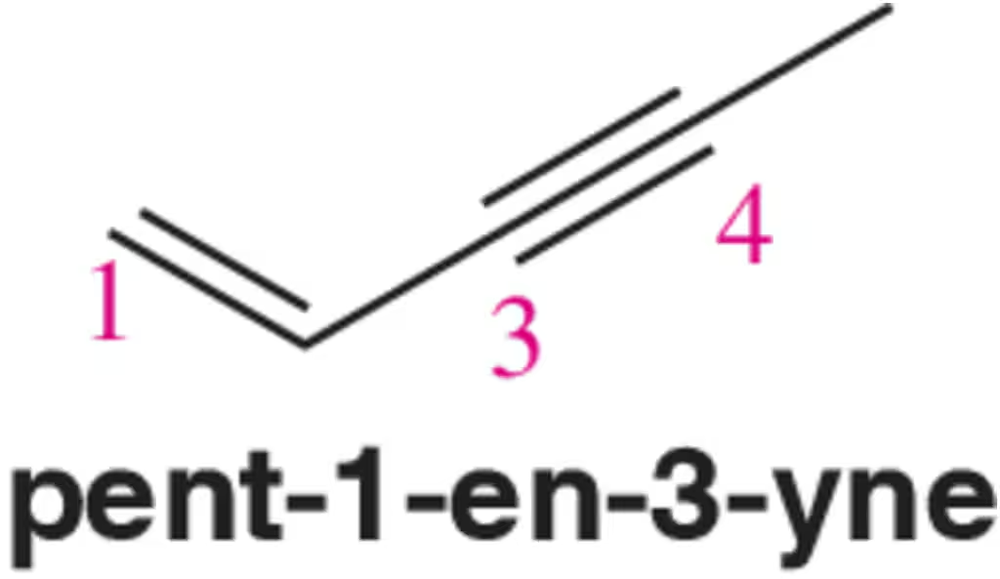
Step 1: Identify the structure of pent-1-en-3-yne. This molecule contains a five-carbon chain with a double bond at the first carbon and a triple bond at the third carbon. Write the condensed structural formula as CH₂=CH-C≡C-CH₃.
Step 2: Determine the hybridization of each carbon atom. The first carbon in the double bond is sp² hybridized, the second carbon in the double bond is sp² hybridized, the third carbon in the triple bond is sp hybridized, the fourth carbon in the triple bond is sp hybridized, and the fifth carbon is sp³ hybridized.
Step 3: Draw the molecular orbitals for each bond type. For the double bond, show one σ bond formed by the overlap of sp² orbitals and one π bond formed by the overlap of unhybridized p orbitals. For the triple bond, show one σ bond formed by the overlap of sp orbitals and two π bonds formed by the overlap of unhybridized p orbitals.
Step 4: Include lone pairs and any remaining orbitals. For sp² and sp hybridized carbons, show the unhybridized p orbitals that contribute to π bonding. For sp³ hybridized carbons, show the tetrahedral arrangement of σ bonds.
Step 5: Assemble the complete molecular orbital diagram, ensuring all bonds and orbitals are represented accurately. Highlight the delocalized π system if applicable, and confirm the geometry matches the hybridization of each atom.
Verified video answer for a similar problem:
This video solution was recommended by our tutors as helpful for the problem above
Video duration:
6m
Play a video:
Was this helpful?
Key Concepts
Here are the essential concepts you must grasp in order to answer the question correctly.
Molecular Orbitals
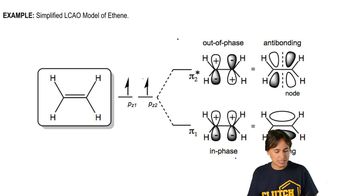
Molecular orbitals (MOs) are formed by the combination of atomic orbitals when atoms bond together. They can be classified as bonding, antibonding, or non-bonding orbitals, which influence the stability and reactivity of the molecule. Understanding MOs is crucial for visualizing electron distribution and predicting molecular properties.
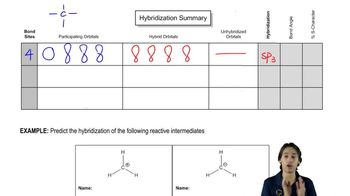
Hybridization is the process of mixing atomic orbitals to create new hybrid orbitals that can form sigma bonds in a molecule. In pent-1-en-3-yne, the carbon atoms undergo sp2 and sp hybridization, which affects the geometry and bonding characteristics of the molecule. Recognizing the type of hybridization helps in drawing accurate molecular structures.
Alkynes and alkenes are types of unsaturated hydrocarbons characterized by the presence of triple and double bonds, respectively. Pent-1-en-3-yne contains both a double bond (alkene) and a triple bond (alkyne), which significantly influence its reactivity and physical properties. Understanding these functional groups is essential for constructing the correct molecular orbital diagram.