
In this reaction scenario, we are working with a nucleophile, specifically terbutoxide, and a leaving group, which is an alkyl fluoride. This situation is ideal for applying a flowchart to determine the type of reaction occurring, particularly focusing on substitution and elimination reactions. The first step involves identifying whether the nucleophile is negatively charged or neutral. In this case, terbutoxide is negatively charged due to the presence of potassium, which acts as a spectator ion.
Next, we assess whether the nucleophile is a bulky base. Terbutoxide qualifies as a bulky base, leading us to conclude that the reaction follows an E2 mechanism, specifically the Hofmann elimination pathway. This is because bulky bases tend to favor the formation of the less substituted product, known as the kinetic product, which is typically the fastest to form.
To identify the beta carbons, we note that there are two beta carbons available, each possessing at least one beta hydrogen. The next consideration is whether these beta hydrogens are in the anti-coplanar position relative to the leaving group. However, since no stereochemistry is provided for the alkyl fluoride, we can disregard this question and conclude that both products can be formed.
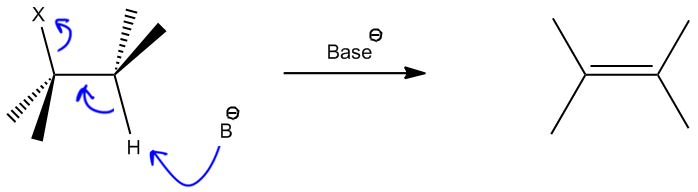
When drawing the mechanism for the major product, we focus on the less substituted direction, targeting a specific beta hydrogen. The mechanism involves the nucleophile (terbutoxide) abstracting the beta hydrogen, forming a double bond while simultaneously expelling the fluoride ion. This results in the formation of a double bond that is less substituted. Conversely, if the reaction were to occur at the other beta carbon, a more substituted double bond would form.
Upon evaluating the substitution of the double bonds, we find that the product from the less substituted pathway is monosubstituted, while the product from the more substituted pathway is trisubstituted. The trisubstituted product is typically more stable, but in this case, the bulky base leads us to prefer the Hofmann product (the less substituted double bond) as the major product, while the more substituted product is considered the minor product. This distinction highlights the concept of dehydrohalogenation in E2 reactions, where the elimination of a hydrogen halide occurs, resulting in the formation of alkenes.