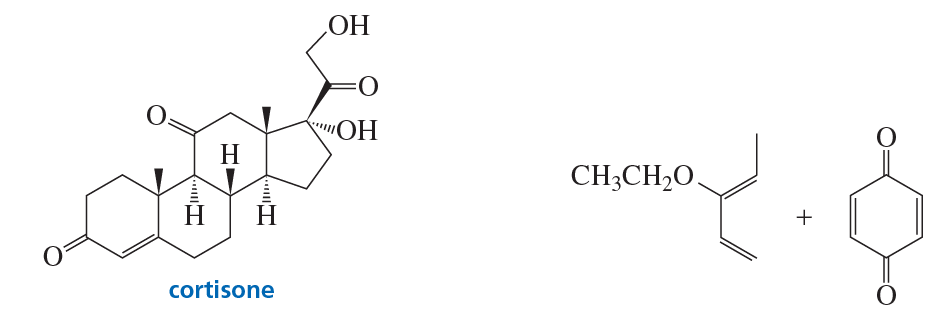
The A ring of cortisone (a steroid) is formed by a Diels–Alder reaction using the two reactants shown here. What is the product of this reaction?
Verified step by step guidance
1
Identify the two reactants in the Diels–Alder reaction: one is the diene (a molecule with two conjugated double bonds), and the other is the dienophile (a molecule with a double or triple bond that reacts with the diene). Analyze the structures provided in the problem to determine which is which.
Understand the mechanism of the Diels–Alder reaction: it is a [4+2] cycloaddition reaction where the diene contributes four π-electrons and the dienophile contributes two π-electrons. This reaction forms a six-membered ring.
Orient the diene and dienophile correctly: ensure that the diene is in the s-cis conformation (both double bonds on the same side of the single bond) to allow for proper orbital overlap. Check for any substituents on the diene or dienophile that may influence regioselectivity or stereoselectivity.
Predict the product: combine the diene and dienophile to form a six-membered ring. Pay attention to the stereochemistry of the product, as the Diels–Alder reaction is stereospecific. If the dienophile has substituents, their stereochemistry (cis or trans) will be preserved in the product.
Verify the structure of the product: ensure that the newly formed six-membered ring matches the A ring of cortisone. Double-check the positions of any substituents and the stereochemistry to confirm the product aligns with the expected outcome.
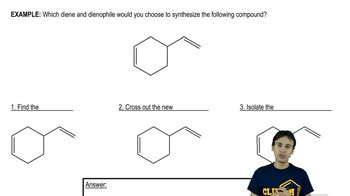
Verified video answer for a similar problem:
This video solution was recommended by our tutors as helpful for the problem above
Video duration:
3m
Play a video:
Was this helpful?
Key Concepts
Here are the essential concepts you must grasp in order to answer the question correctly.
Diels–Alder Reaction
The Diels–Alder reaction is a [4+2] cycloaddition reaction between a conjugated diene and a dienophile, resulting in the formation of a six-membered ring. This reaction is a key method in organic synthesis for constructing cyclic compounds and is characterized by its stereospecificity and regioselectivity. Understanding the mechanism and the orientation of the reactants is crucial for predicting the product.
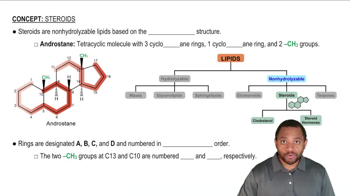
Steroids are a class of organic compounds characterized by a core structure of four fused carbon rings, known as the steroid nucleus. The specific arrangement of functional groups and the stereochemistry of these rings influence the biological activity and properties of steroids. Recognizing the A, B, C, and D rings in steroids is essential for understanding their synthesis and reactivity.
Identifying the correct reactants in a Diels–Alder reaction is critical for predicting the product. The diene must be in an appropriate conformation to react with the dienophile, which can be an alkene or alkyne. Understanding the electronic and steric properties of the reactants helps in determining the feasibility of the reaction and the nature of the resulting product.