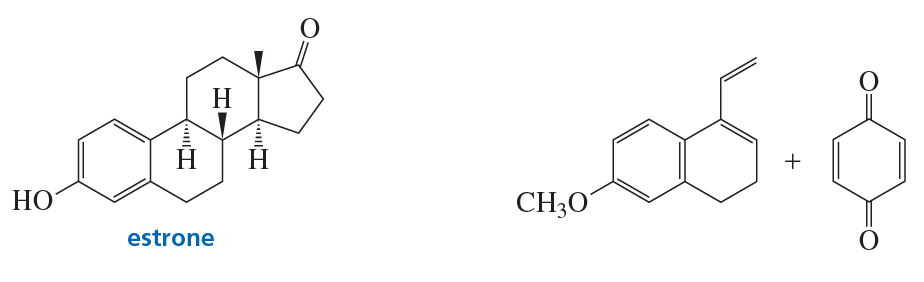
The C ring of estrone (a steroid) is formed by a Diels–Alder reaction using the two reactants shown here. What is the product of this reaction?
Verified step by step guidance
1
Identify the components of the Diels–Alder reaction: The Diels–Alder reaction is a [4+2] cycloaddition reaction between a conjugated diene and a dienophile. In this case, examine the two reactants provided in the problem to determine which is the diene (a molecule with two conjugated double bonds) and which is the dienophile (a molecule with one double bond, often activated by electron-withdrawing groups).
Analyze the diene: Confirm that the diene has a conjugated system of alternating double and single bonds, which allows it to participate in the reaction. Ensure the diene is in the s-cis conformation, as this is required for the reaction to proceed.
Analyze the dienophile: Check for the presence of a double bond in the dienophile and any electron-withdrawing groups (e.g., carbonyl groups) that make it more reactive. These groups lower the energy of the dienophile's lowest unoccupied molecular orbital (LUMO), facilitating the reaction.
Predict the regioselectivity and stereochemistry: Use the electron density of the diene and dienophile to predict how the two molecules will align during the reaction. Consider the endo rule, which states that the product will favor the endo configuration (where substituents on the dienophile are oriented toward the diene's π system) due to secondary orbital interactions.
Draw the product: Combine the diene and dienophile to form a six-membered ring. Ensure that the new σ bonds are formed between the terminal carbons of the diene and the carbons of the dienophile's double bond. Add any substituents from the dienophile to the appropriate positions on the ring, keeping in mind the stereochemistry predicted in the previous step.
Verified video answer for a similar problem:
This video solution was recommended by our tutors as helpful for the problem above
Video duration:
5m
Play a video:
Was this helpful?
Key Concepts
Here are the essential concepts you must grasp in order to answer the question correctly.
Diels–Alder Reaction
The Diels–Alder reaction is a [4+2] cycloaddition reaction between a conjugated diene and a dienophile, resulting in the formation of a six-membered ring. This reaction is a key method in organic synthesis for constructing cyclic compounds and is characterized by its stereospecificity and regioselectivity. Understanding the mechanism involves recognizing the electron-rich diene and the electron-poor dienophile, which interact to form new sigma bonds.
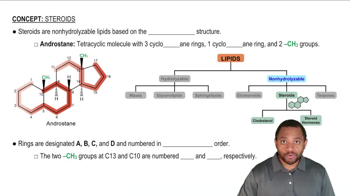
Steroids are a class of organic compounds characterized by a core structure of four fused carbon rings, known as the steroid nucleus. The specific arrangement of functional groups and the orientation of these rings determine the biological activity and properties of the steroid. Estrone, as a steroid, has a specific configuration that influences its reactivity and the types of reactions it can undergo, including the Diels–Alder reaction.
Predicting the product of an organic reaction involves understanding the reactants' structures, the reaction mechanism, and the stability of potential products. In the case of the Diels–Alder reaction, the orientation and substitution patterns of the diene and dienophile can lead to different regioisomers or stereoisomers. Analyzing these factors allows chemists to anticipate the most likely product formed from the reaction.