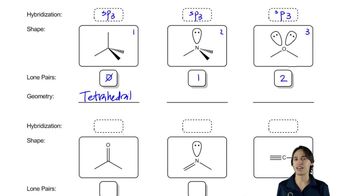
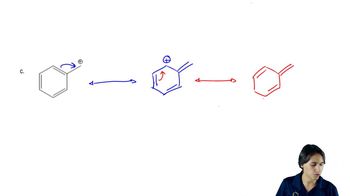
Predict the hybridization and geometry of the carbon and nitrogen atoms in the following molecules and ions. (Hint: Resonance.) d.
Verified step by step guidance
1
Identify the molecule as pyridine, which is a six-membered aromatic ring containing one nitrogen atom.
Recognize that pyridine is similar to benzene in terms of its aromaticity, with a nitrogen atom replacing one of the CH groups.
Determine the hybridization of the carbon atoms in the ring. Each carbon atom in pyridine is bonded to three other atoms (two carbons and one hydrogen) and participates in a pi bond, indicating sp2 hybridization.
Examine the nitrogen atom in pyridine. It is bonded to two carbon atoms and has a lone pair of electrons. The nitrogen atom is also sp2 hybridized, with the lone pair occupying an sp2 orbital, allowing it to participate in the aromatic pi system.
Conclude that the geometry around each carbon and the nitrogen atom is trigonal planar due to the sp2 hybridization, which is consistent with the planar structure of aromatic compounds.
Verified video answer for a similar problem:
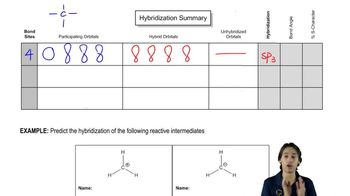
This video solution was recommended by our tutors as helpful for the problem above
Video duration:
4m
Play a video:
Was this helpful?
Key Concepts
Here are the essential concepts you must grasp in order to answer the question correctly.
Hybridization
Hybridization is the process of mixing atomic orbitals to form new hybrid orbitals, which can explain the geometry of molecular bonding. In organic chemistry, carbon atoms typically undergo sp3, sp2, or sp hybridization, leading to tetrahedral, trigonal planar, or linear geometries, respectively. For nitrogen in aromatic compounds, sp2 hybridization is common, allowing for planar structures and resonance stabilization.
Molecular geometry refers to the three-dimensional arrangement of atoms within a molecule. It is determined by the hybridization of the central atom and the repulsion between electron pairs. In the context of aromatic compounds, such as pyridine, the geometry is often trigonal planar due to sp2 hybridization, which allows for resonance and delocalization of electrons across the ring structure.
Resonance is a concept used to describe the delocalization of electrons in molecules that cannot be represented by a single Lewis structure. It involves the depiction of multiple contributing structures, which collectively describe the electron distribution. In aromatic compounds, resonance contributes to stability by allowing electrons to be shared across the entire ring, influencing both hybridization and geometry.