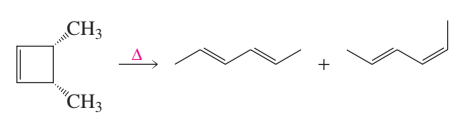
cis-3,4-Dimethylcyclobutene undergoes thermal ring opening to form the two products shown. One of the products is formed in 99% yield, the other in 1% yield. Which is which?
Verified step by step guidance
1
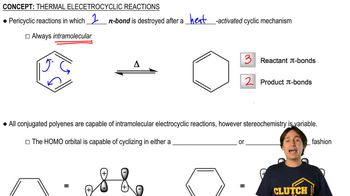
Step 1: Recognize that the thermal ring opening of cis-3,4-dimethylcyclobutene is a pericyclic reaction, specifically a conrotatory ring-opening process governed by the Woodward-Hoffmann rules for electrocyclic reactions.
Step 2: Analyze the stereochemistry of the starting material. The cis configuration of the methyl groups on the cyclobutene ring will influence the geometry of the products formed during the ring-opening process.
Step 3: Predict the products based on the conrotatory mechanism. The conrotatory motion will lead to two possible products: one with conjugated double bonds (more stable due to resonance stabilization) and another with isolated double bonds (less stable).
Step 4: Compare the stability of the two products. The product with conjugated double bonds is significantly more stable due to delocalization of π-electrons, which lowers the overall energy of the molecule. The product with isolated double bonds lacks this stabilization.
Step 5: Assign the major and minor products based on their stability. The conjugated product is formed in 99% yield due to its greater thermodynamic stability, while the isolated double bond product is formed in only 1% yield.
Verified video answer for a similar problem:
This video solution was recommended by our tutors as helpful for the problem above
Play a video:
Was this helpful?
Key Concepts
Here are the essential concepts you must grasp in order to answer the question correctly.
Thermal Ring Opening
Thermal ring opening refers to the process where a cyclic compound, such as a cyclobutene, undergoes a reaction upon heating that breaks the ring structure, resulting in the formation of linear or branched products. This reaction is often favored in certain cyclic compounds due to the strain in the ring, which can be relieved by forming more stable open-chain structures.
Regioselectivity is the preference of a chemical reaction to yield one structural isomer over others when multiple products are possible. In the case of the thermal ring opening of cis-3,4-Dimethylcyclobutene, the formation of one product in 99% yield suggests that the reaction is highly regioselective, favoring the formation of a more stable or lower-energy product due to factors such as sterics or electronic effects.
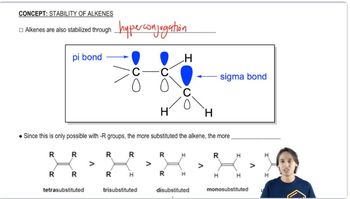
The stability of alkenes is influenced by their degree of substitution; more substituted alkenes are generally more stable due to hyperconjugation and the inductive effect. In the context of the products formed from the ring opening of cis-3,4-Dimethylcyclobutene, the more substituted alkene is likely the one formed in higher yield, as it is thermodynamically favored compared to the less substituted counterpart.