b. What would be the product if trans-2-butene were used instead of ethene?
Verified step by step guidance
1
Step 1: Recognize the reaction type. The given reaction is a Diels-Alder reaction, which is a [4+2] cycloaddition between a conjugated diene and a dienophile. In the image, the diene is cyclopentadiene, and the dienophile is ethene.
Step 2: Understand the role of trans-2-butene. If trans-2-butene is used instead of ethene, it will act as the dienophile in the Diels-Alder reaction. Trans-2-butene has a double bond and substituents (methyl groups) on opposite sides of the double bond.
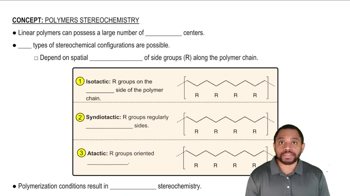
Step 3: Predict the stereochemistry of the product. The Diels-Alder reaction is stereospecific, meaning the stereochemistry of the dienophile (trans configuration) will be preserved in the product. The substituents on trans-2-butene will end up on opposite sides of the newly formed six-membered ring.
Step 4: Draw the product structure. Combine the diene (cyclopentadiene) and the dienophile (trans-2-butene) to form a bicyclic compound. The product will have a six-membered ring fused to the cyclopentadiene, with the methyl groups on opposite sides of the six-membered ring.
Step 5: Verify the regioselectivity. The Diels-Alder reaction typically follows the endo rule, favoring the formation of the endo product where substituents are oriented towards the larger ring system. Ensure the methyl groups are positioned correctly in the product structure.
Verified video answer for a similar problem:
This video solution was recommended by our tutors as helpful for the problem above
Video duration:
2m
Play a video:
Was this helpful?
Key Concepts
Here are the essential concepts you must grasp in order to answer the question correctly.
Alkenes and Their Reactions
Alkenes are hydrocarbons that contain at least one carbon-carbon double bond. They are reactive due to the presence of this double bond, which can participate in various addition reactions. Understanding the reactivity of alkenes is crucial for predicting the products of reactions, especially when substituting different alkenes, such as trans-2-butene for ethene.
Stereochemistry refers to the study of the spatial arrangement of atoms in molecules and how this affects their chemical behavior. In the case of trans-2-butene, the specific arrangement of substituents around the double bond influences the type of products formed during reactions. Recognizing the stereochemical configuration is essential for understanding the outcome of reactions involving alkenes.
Electrophilic addition is a common reaction mechanism for alkenes, where an electrophile reacts with the double bond, leading to the formation of a more stable product. This mechanism typically involves the formation of a carbocation intermediate. The nature of the alkene, such as whether it is trans or cis, can affect the stability of intermediates and the final product distribution.