
Draw the NMR spectrum expected from ethanol that has been shaken with a drop of D2O.
Verified step by step guidance
1
Step 1: Understand the impact of D2O on ethanol. When ethanol is shaken with D2O, the hydroxyl proton (H from -OH group) undergoes exchange with deuterium (D) from D2O. This results in the replacement of the -OH proton with deuterium, which is not detected in proton NMR.
Step 2: Analyze the remaining protons in ethanol. Ethanol (CH3CH2OH) has two types of protons that will appear in the NMR spectrum: the protons in the methyl group (-CH3) and the protons in the methylene group (-CH2). The hydroxyl proton is replaced by deuterium and will not contribute to the spectrum.
Step 3: Predict the splitting patterns. The methyl group (-CH3) protons will experience splitting due to the neighboring methylene (-CH2) group, resulting in a triplet signal. The methylene (-CH2) protons will experience splitting due to the neighboring methyl (-CH3) group, resulting in a quartet signal.
Step 4: Consider the chemical shifts. The methyl group (-CH3) protons will appear upfield (lower chemical shift) due to their electron-rich environment, while the methylene (-CH2) protons will appear downfield (higher chemical shift) due to their proximity to the electronegative oxygen atom.
Step 5: Summarize the expected NMR spectrum. The spectrum will consist of two signals: a triplet for the methyl group (-CH3) and a quartet for the methylene group (-CH2), with the hydroxyl proton signal absent due to deuterium exchange.
Verified video answer for a similar problem:
This video solution was recommended by our tutors as helpful for the problem above
Video duration:
10m
Play a video:
Was this helpful?
Key Concepts
Here are the essential concepts you must grasp in order to answer the question correctly.
Nuclear Magnetic Resonance (NMR) Spectroscopy
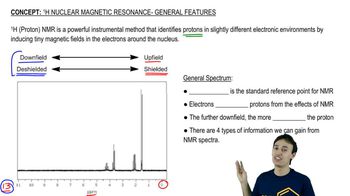
NMR spectroscopy is a powerful analytical technique used to determine the structure of organic compounds. It relies on the magnetic properties of certain nuclei, such as hydrogen (1H) and carbon (13C), to provide information about the environment surrounding these nuclei. The resulting spectrum displays peaks that correspond to different chemical environments, allowing chemists to infer structural details about the molecule.
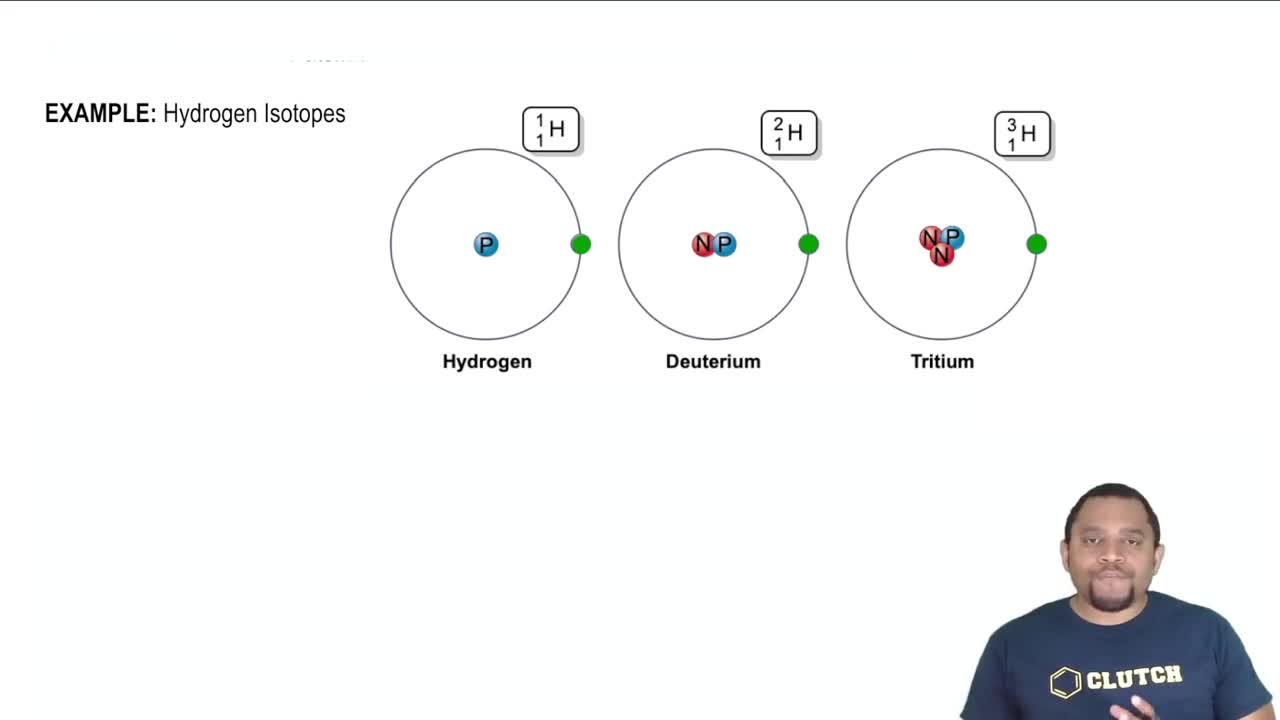
Deuterium exchange occurs when a hydrogen atom in a molecule is replaced by a deuterium atom (D), which is an isotope of hydrogen. In the context of ethanol shaken with D2O, the hydroxyl (–OH) hydrogen can exchange with deuterium, leading to the formation of deuterated ethanol. This exchange affects the NMR spectrum by altering the number and position of peaks, particularly in the region corresponding to the hydroxyl group.
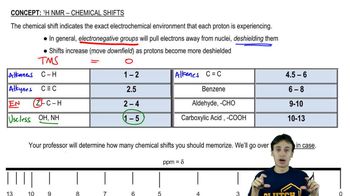
Chemical shift refers to the variation in the resonance frequency of a nucleus due to its electronic environment. In NMR spectroscopy, different functional groups and molecular environments cause shifts in the position of peaks on the spectrum. For ethanol, the chemical shifts of the protons in the –OH, –CH2, and –CH3 groups will be distinct, and the exchange with deuterium will lead to a noticeable change in the peak corresponding to the hydroxyl proton.