
(b) Draw the proton NMR spectrum you would expect for butan-2-one. How well do the proton chemical shifts predict the carbon chemical shifts using the "15 to 20 times as large" rule of thumb?
Verified step by step guidance
1
Step 1: Identify the structure of butan-2-one. Butan-2-one is a ketone with the molecular formula C4H8O. Its structure consists of a ketone group (C=O) at the second carbon, flanked by methyl groups on either side.
Step 2: Analyze the proton environments in butan-2-one. There are two distinct proton environments: (1) the methyl group adjacent to the carbonyl group (CH3-C=O), which experiences deshielding due to the electron-withdrawing effect of the carbonyl group, and (2) the terminal methyl group (CH3-CH2), which is less affected by the carbonyl group.
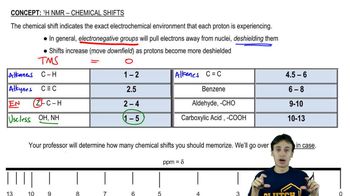
Step 3: Predict the chemical shifts for the proton NMR spectrum. The protons in the CH3-C=O group will appear downfield (higher ppm) due to deshielding, typically around 2.0-2.5 ppm. The protons in the CH3-CH2 group will appear upfield (lower ppm), typically around 0.9-1.2 ppm.
Step 4: Consider the '15 to 20 times as large' rule of thumb for predicting carbon chemical shifts. Carbon chemical shifts are generally 15 to 20 times larger than proton chemical shifts. For example, if the proton chemical shift for CH3-C=O is around 2.5 ppm, the corresponding carbon chemical shift for the carbonyl carbon might be approximately 37.5-50 ppm.
Step 5: Compare the predicted proton and carbon chemical shifts. Using the rule of thumb, verify whether the predicted carbon chemical shifts align with the expected values based on the proton chemical shifts. This comparison helps validate the relationship between proton and carbon environments in NMR spectroscopy.
Verified video answer for a similar problem:
This video solution was recommended by our tutors as helpful for the problem above
Video duration:
4m
Play a video:
Was this helpful?
Key Concepts
Here are the essential concepts you must grasp in order to answer the question correctly.
Proton NMR Spectroscopy
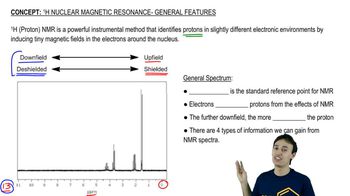
Proton Nuclear Magnetic Resonance (NMR) spectroscopy is a technique used to determine the structure of organic compounds by analyzing the magnetic environment of hydrogen atoms in a molecule. In the spectrum, peaks correspond to different hydrogen environments, and their chemical shifts provide information about the electronic surroundings of the protons, allowing for the identification of functional groups and molecular structure.
Chemical shifts in NMR spectroscopy refer to the resonance frequency of a nucleus relative to a standard reference frequency, typically measured in parts per million (ppm). The position of a peak in the NMR spectrum indicates the electronic environment of the protons, influenced by factors such as electronegativity and hybridization. Understanding chemical shifts is crucial for interpreting the NMR spectrum and predicting the structure of the compound.
The '15 to 20 times as large' rule is a heuristic used in organic chemistry to estimate carbon chemical shifts based on proton chemical shifts. This rule suggests that the carbon chemical shift will typically be 15 to 20 times greater than the corresponding proton chemical shift due to the differences in the magnetic environment and the number of protons influencing the carbon atom. This relationship helps chemists predict carbon shifts when analyzing NMR data.