

a. Which reacts faster in an E2 reaction: 3-bromocyclohexene or bromocyclohexane? b. Which reacts faster in an E1 reaction?
Verified step by step guidance
1
Step 1: Understand the E2 reaction mechanism. The E2 reaction is a bimolecular elimination reaction where the rate depends on both the substrate and the base. It requires a strong base and a good leaving group. The reaction proceeds via a single concerted step, and the geometry of the β-hydrogens (anti-periplanar to the leaving group) is critical.
Step 2: Analyze the structure of 3-bromocyclohexene. In this molecule, the bromine atom is attached to a cyclohexene ring. The double bond in the cyclohexene ring introduces rigidity, which can influence the anti-periplanar geometry required for the E2 reaction.
Step 3: Analyze the structure of bromocyclohexane. In this molecule, the bromine atom is attached to a cyclohexane ring. The absence of a double bond allows for more conformational flexibility, which can make it easier to achieve the anti-periplanar geometry required for the E2 reaction.
Step 4: Compare the two molecules for the E2 reaction. The rigidity of the double bond in 3-bromocyclohexene may hinder the anti-periplanar geometry, making bromocyclohexane react faster in an E2 reaction.
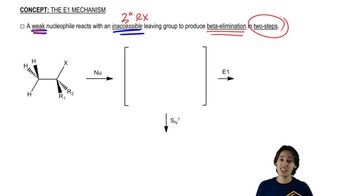
Step 5: For the E1 reaction, consider the stability of the carbocation intermediate. The E1 reaction proceeds via a two-step mechanism where the leaving group departs first, forming a carbocation. The double bond in 3-bromocyclohexene can stabilize the carbocation through resonance, making it react faster in an E1 reaction compared to bromocyclohexane.
Verified video answer for a similar problem:
This video solution was recommended by our tutors as helpful for the problem above
Video duration:
6m
Play a video:
Was this helpful?
Key Concepts
Here are the essential concepts you must grasp in order to answer the question correctly.
E2 Reaction Mechanism
The E2 (bimolecular elimination) reaction is a concerted process where a base abstracts a proton while a leaving group departs, resulting in the formation of a double bond. The rate of an E2 reaction depends on the strength of the base and the structure of the substrate. Steric hindrance and the stability of the transition state play crucial roles, with more substituted substrates typically reacting faster.
The E1 (unimolecular elimination) reaction involves two steps: first, the formation of a carbocation intermediate after the leaving group departs, followed by deprotonation to form a double bond. The rate of an E1 reaction is primarily dependent on the stability of the carbocation formed. Tertiary carbocations are more stable and thus react faster in E1 mechanisms compared to primary or secondary ones.
The structure of the substrate significantly influences the reactivity in both E1 and E2 reactions. In E2 reactions, steric factors and the ability to form a stable transition state are critical, while in E1 reactions, the stability of the carbocation intermediate is paramount. For example, cyclohexene derivatives may exhibit different reactivity patterns based on their ring strain and substitution, affecting the overall reaction rate.