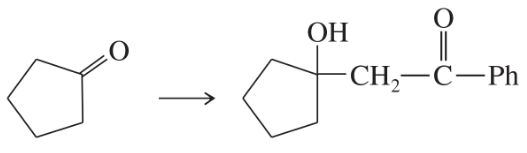
Show how you would accomplish the following syntheses. You may use whatever additional reagents you need. (e)
Verified step by step guidance
1
Step 1: Begin with the starting material, cyclopentanone. The goal is to convert the ketone group into a hydroxyl group while introducing a benzoyl group (C=O attached to a phenyl group) at the alpha position.
Step 2: Perform an alpha-alkylation reaction. First, generate the enolate of cyclopentanone by treating it with a strong base such as LDA (Lithium Diisopropylamide). This enolate will act as a nucleophile.
Step 3: Introduce the benzoyl group by reacting the enolate with benzyl bromide (PhCH2Br) in an SN2 reaction. This will add the benzyl group to the alpha position of the cyclopentanone.
Step 4: Oxidize the benzyl group to a benzoyl group. Use an oxidizing agent such as PCC (Pyridinium Chlorochromate) or Jones reagent to convert the CH2 group into a C=O group.
Step 5: Reduce the ketone group in cyclopentanone to a hydroxyl group. Use a reducing agent such as NaBH4 (Sodium Borohydride) or LiAlH4 (Lithium Aluminum Hydride) to achieve this transformation, yielding the final product.
Verified video answer for a similar problem:
This video solution was recommended by our tutors as helpful for the problem above
Video duration:
6m
Play a video:
Was this helpful?
Key Concepts
Here are the essential concepts you must grasp in order to answer the question correctly.
Organic Synthesis
Organic synthesis is the process of constructing organic compounds through chemical reactions. It involves the strategic selection of starting materials and reagents to achieve a desired product. Understanding the principles of synthesis is crucial for designing pathways that efficiently convert reactants into target molecules while considering factors like yield and selectivity.
Synthesis of Amino Acids: Strecker Synthesis Example 1
Reaction Mechanisms
A reaction mechanism describes the step-by-step sequence of elementary reactions that occur during a chemical transformation. It provides insight into how bonds are broken and formed, and the intermediates that may be involved. Familiarity with mechanisms is essential for predicting the outcomes of reactions and for selecting appropriate reagents in synthesis.
Functional groups are specific groups of atoms within molecules that are responsible for the characteristic chemical reactions of those molecules. Recognizing functional groups is vital in organic chemistry as they dictate the reactivity and properties of compounds. Understanding how different functional groups interact can guide the selection of reagents and conditions for successful synthesis.