Rationalize the difference in Kₑq for the following reactions. Be sure to account for both ∆S and ∆H.
Verified step by step guidance
1
Begin by understanding the concept of equilibrium constant (Kₑq). It is a measure of the extent of a chemical reaction at equilibrium, and it is influenced by the changes in enthalpy (∆H) and entropy (∆S) of the reaction.
Recall the Gibbs free energy equation: . This equation relates the change in Gibbs free energy (∆G) to the changes in enthalpy (∆H) and entropy (∆S), where T is the temperature in Kelvin.
Understand that the equilibrium constant Kₑq is related to Gibbs free energy by the equation: , where R is the universal gas constant. This shows that Kₑq is exponentially dependent on ∆G.
Analyze how ∆H and ∆S affect ∆G. A negative ∆H (exothermic reaction) tends to favor product formation, increasing Kₑq, while a positive ∆S (increase in disorder) also favors product formation, increasing Kₑq. Conversely, a positive ∆H or negative ∆S would decrease Kₑq.
Compare the reactions by evaluating their ∆H and ∆S values. Consider how these values influence ∆G and subsequently Kₑq. A reaction with a more negative ∆G will have a larger Kₑq, indicating a greater extent of reaction towards products at equilibrium.
Verified video answer for a similar problem:
This video solution was recommended by our tutors as helpful for the problem above
Video duration:
9m
Play a video:
Was this helpful?
Key Concepts
Here are the essential concepts you must grasp in order to answer the question correctly.
Equilibrium Constant (Kₑq)
The equilibrium constant, Kₑq, is a measure of the ratio of the concentrations of products to reactants at equilibrium for a given reaction. It reflects the extent to which a reaction proceeds and is influenced by temperature and the nature of the reactants and products. A higher Kₑq indicates a greater concentration of products relative to reactants at equilibrium.
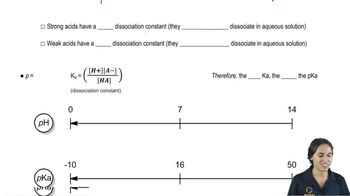
The relationship between equilibrium constant and pKa.
Enthalpy Change (∆H)
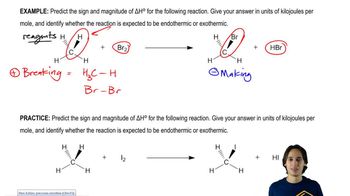
Enthalpy change, ∆H, represents the heat absorbed or released during a chemical reaction at constant pressure. It is a key factor in determining the favorability of a reaction; exothermic reactions (negative ∆H) tend to be more favorable as they release energy, while endothermic reactions (positive ∆H) require energy input. ∆H influences the equilibrium position by affecting the energy balance of the reaction.
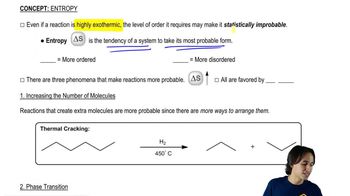
Entropy change, ∆S, measures the change in disorder or randomness in a system during a chemical reaction. A positive ∆S indicates an increase in disorder, which can favor the spontaneity of a reaction. Entropy is a crucial component of the Gibbs free energy equation, which determines the spontaneity of a reaction. ∆S, along with ∆H, affects the equilibrium constant by influencing the overall energy dynamics of the reaction.