Rank imidazole, pyrrole, and benzene from most reactive to least reactive toward electrophilic aromatic substitution.
Verified step by step guidance
1
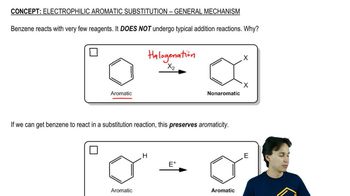
Understand the concept of electrophilic aromatic substitution (EAS): This reaction involves the replacement of a hydrogen atom on an aromatic ring with an electrophile. The reactivity of the aromatic compound depends on the electron density of the ring, which is influenced by the substituents or heteroatoms present in the structure.
Analyze the structure of imidazole: Imidazole contains two nitrogen atoms in a five-membered aromatic ring. One nitrogen has a lone pair that participates in the aromaticity of the ring, while the other nitrogen has a lone pair that is not involved in aromaticity. This makes imidazole electron-rich and highly reactive toward electrophiles.
Analyze the structure of pyrrole: Pyrrole is a five-membered aromatic ring with one nitrogen atom. The lone pair on the nitrogen is delocalized into the aromatic system, increasing the electron density of the ring. However, it is slightly less electron-rich compared to imidazole because it has only one nitrogen contributing to the electron density.
Analyze the structure of benzene: Benzene is a six-membered aromatic ring with no heteroatoms. Its electron density is evenly distributed across the ring, making it less reactive toward electrophiles compared to imidazole and pyrrole.
Rank the compounds based on their reactivity: Since imidazole has the highest electron density due to the presence of two nitrogen atoms, it is the most reactive. Pyrrole, with one nitrogen atom, is less reactive than imidazole but more reactive than benzene. Benzene, with no heteroatoms, is the least reactive. Therefore, the order of reactivity is: imidazole > pyrrole > benzene.
Verified video answer for a similar problem:
This video solution was recommended by our tutors as helpful for the problem above
Play a video:
Was this helpful?
Key Concepts
Here are the essential concepts you must grasp in order to answer the question correctly.
Electrophilic Aromatic Substitution (EAS)
Electrophilic Aromatic Substitution is a fundamental reaction in organic chemistry where an electrophile replaces a hydrogen atom on an aromatic ring. The reactivity of the aromatic compound is influenced by the electron density of the ring, which is affected by substituents. Understanding EAS is crucial for ranking the reactivity of compounds like imidazole, pyrrole, and benzene.
Aromatic compounds are characterized by their stable ring structure and delocalized π-electrons, which contribute to their unique reactivity. The electron density on the ring determines how readily it can react with electrophiles. Compounds with higher electron density are generally more reactive in EAS, making the concept of aromaticity essential for comparing imidazole, pyrrole, and benzene.
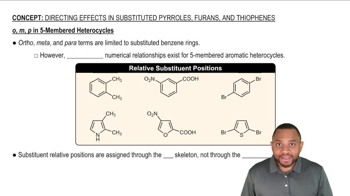
The presence of different substituents on an aromatic ring can significantly influence its reactivity toward electrophiles. Electron-donating groups increase electron density and enhance reactivity, while electron-withdrawing groups decrease it. In the case of imidazole, pyrrole, and benzene, understanding how their structures affect electron donation is key to ranking their reactivity in EAS.