
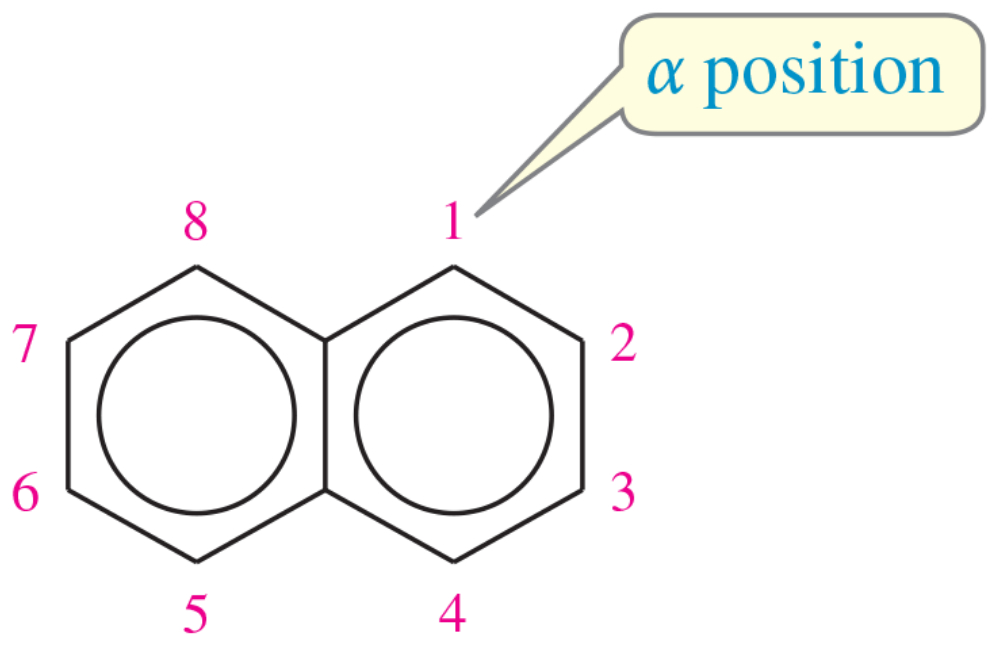

Electrophilic aromatic substitution usually occurs at the 1-position of naphthalene, also called the a position. Predict the major products of the reactions of naphthalene with the following reagents. (a) HNO3, H2SO4 (b) Br2, FeBr3 (c) CH3CH2COCl, AlCl3
Verified step by step guidance
1
Step 1: Understand the concept of electrophilic aromatic substitution (EAS). Naphthalene undergoes EAS reactions where the electrophile preferentially attacks the α-position (1-position) due to its higher reactivity and stability of the intermediate carbocation formed.
Step 2: For reaction (a) with HNO3 and H2SO4, this is a nitration reaction. The nitronium ion (NO2⁺) acts as the electrophile, and it will attack the α-position of naphthalene to form 1-nitronaphthalene. The reaction mechanism involves the generation of NO2⁺ from HNO3 and H2SO4, followed by its attack on the aromatic ring.
Step 3: For reaction (b) with Br2 and FeBr3, this is a bromination reaction. FeBr3 acts as a Lewis acid catalyst to generate the bromonium ion (Br⁺) from Br2. The bromonium ion will attack the α-position of naphthalene, leading to the formation of 1-bromonaphthalene.
Step 4: For reaction (c) with CH3CH2COCl and AlCl3, this is a Friedel-Crafts acylation reaction. AlCl3 acts as a Lewis acid catalyst to generate the acylium ion (CH3CH2CO⁺) from CH3CH2COCl. The acylium ion will attack the α-position of naphthalene, resulting in the formation of 1-(propanoyl)naphthalene.
Step 5: Summarize the major products for each reaction: (a) 1-nitronaphthalene, (b) 1-bromonaphthalene, and (c) 1-(propanoyl)naphthalene. These products are formed due to the preferential attack at the α-position of naphthalene during electrophilic aromatic substitution.
Verified video answer for a similar problem:
This video solution was recommended by our tutors as helpful for the problem above
Video duration:
3m
Play a video:
Was this helpful?
Key Concepts
Here are the essential concepts you must grasp in order to answer the question correctly.
Electrophilic Aromatic Substitution (EAS)
Electrophilic Aromatic Substitution is a fundamental reaction in organic chemistry where an electrophile replaces a hydrogen atom on an aromatic ring. This reaction typically occurs at positions that are more electron-rich, such as the ortho and para positions relative to existing substituents. Understanding the mechanism of EAS, which involves the formation of a sigma complex and subsequent deprotonation, is crucial for predicting the products of reactions involving aromatic compounds.
Naphthalene is a polycyclic aromatic hydrocarbon consisting of two fused benzene rings. Its structure allows for multiple substitution positions, with the 1-position (alpha position) being the most reactive site for electrophilic substitution due to its higher electron density. Recognizing the positions on naphthalene and their relative reactivity is essential for predicting the outcomes of reactions with various electrophiles.
The choice of reagents in electrophilic aromatic substitution significantly influences the reaction pathway and product distribution. For example, nitration (using HNO3 and H2SO4) introduces a nitro group, bromination (using Br2 and FeBr3) adds a bromine atom, and acylation (using CH3CH2COCl and AlCl3) introduces an acyl group. Understanding how these reagents interact with naphthalene helps in predicting the major products formed during the reactions.