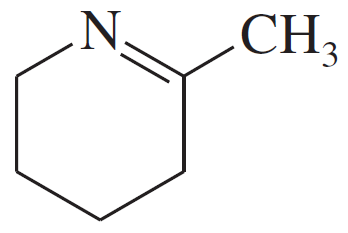
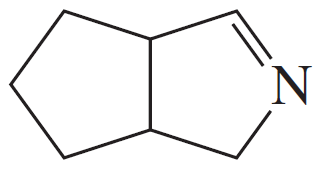
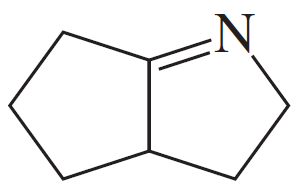
Give the structures of the carbonyl compound and the amine used to form the following imines. (d) (e) (f)
Verified step by step guidance
1
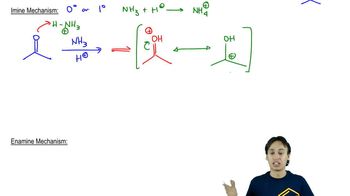
Step 1: Understand the reaction that forms imines. Imines are formed by the condensation reaction between a carbonyl compound (aldehyde or ketone) and a primary amine. During this reaction, the oxygen from the carbonyl group is replaced by the nitrogen from the amine, forming a C=N bond.
Step 2: Analyze structure (a). The imine shown has a C=N bond within a bicyclic structure. To deduce the starting materials, identify the carbon atom bonded to the nitrogen in the imine. This carbon was originally part of a carbonyl group (likely a ketone). The nitrogen atom came from a primary amine. The carbonyl compound would be cyclohexanone, and the amine would be cyclohexylamine.
Step 3: Analyze structure (b). The imine shown has a C=N bond within a bicyclic structure similar to (a). The carbonyl compound would again be cyclohexanone, but the amine would be a different primary amine, specifically cyclohexylamine with a different substitution pattern.
Step 4: Analyze structure (c). The imine shown has a C=N bond attached to a benzene ring and a methyl group on the nitrogen. The carbonyl compound would be benzaldehyde (an aldehyde with a benzene ring), and the amine would be methylamine (a primary amine with a single methyl group).
Step 5: Summarize the process. For each imine, identify the carbonyl compound and the amine by analyzing the structure of the imine and tracing back to the original reactants. This involves recognizing the C=N bond and determining the source of the carbon and nitrogen atoms in the imine.
Verified video answer for a similar problem:
This video solution was recommended by our tutors as helpful for the problem above
Video duration:
5m
Play a video:
Was this helpful?
Key Concepts
Here are the essential concepts you must grasp in order to answer the question correctly.
Carbonyl Compounds
Carbonyl compounds are organic molecules characterized by the presence of a carbonyl group (C=O). This functional group is pivotal in organic chemistry as it participates in various reactions, including nucleophilic addition, which is essential for forming imines. Common examples include aldehydes and ketones, which can react with amines to produce imines.
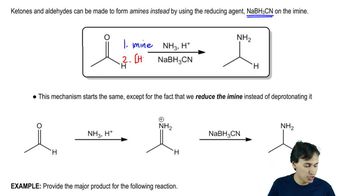
Imines are a class of compounds formed by the reaction of a carbonyl compound with an amine, resulting in a C=N bond. This reaction typically involves the nucleophilic attack of the amine on the carbonyl carbon, followed by the elimination of water. Imines are important intermediates in organic synthesis and can be further transformed into various functional groups.
Amines are organic compounds derived from ammonia (NH3) by replacing one or more hydrogen atoms with alkyl or aryl groups. They can act as nucleophiles due to the lone pair of electrons on the nitrogen atom, allowing them to react with electrophiles such as carbonyl compounds. Understanding the structure and reactivity of amines is crucial for predicting their behavior in imine formation.