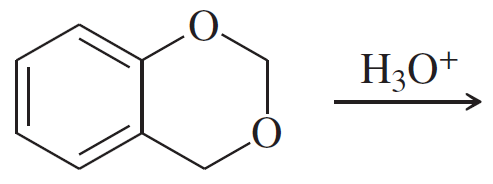
Predict the major products of the following reactions. (i)
Verified step by step guidance
1
Step 1: Identify the functional groups in the reactants. The starting compound is cyclohexanone, which contains a ketone functional group (C=O). The reagent is aniline (PhNH2), which contains an amine group (-NH2) attached to a phenyl ring.
Step 2: Recognize the type of reaction. This is a nucleophilic addition reaction where the amine group of aniline will react with the carbonyl group of cyclohexanone. The reaction typically forms an imine (Schiff base) as the major product.
Step 3: Understand the mechanism. The lone pair of electrons on the nitrogen atom of aniline will attack the electrophilic carbon of the carbonyl group in cyclohexanone. This forms a tetrahedral intermediate.
Step 4: Eliminate water. After the intermediate forms, a dehydration step occurs, where a molecule of water is eliminated to form the imine product. The final product will have a C=N bond with the phenyl group attached to the nitrogen.
Step 5: Verify the structure of the product. The major product will be N-phenylcyclohexylimine, which has the structure: cyclohexane ring with a double bond to nitrogen, and the nitrogen bonded to a phenyl group.
Verified video answer for a similar problem:
This video solution was recommended by our tutors as helpful for the problem above
Video duration:
2m
Play a video:
Was this helpful?
Key Concepts
Here are the essential concepts you must grasp in order to answer the question correctly.
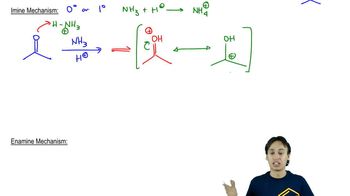
Imine Formation
Imine formation is a reaction between a carbonyl compound (like an aldehyde or ketone) and an amine, resulting in the creation of an imine. This process involves the nucleophilic attack of the amine on the carbonyl carbon, followed by the elimination of water. Understanding this mechanism is crucial for predicting the products of reactions involving carbonyls and amines.
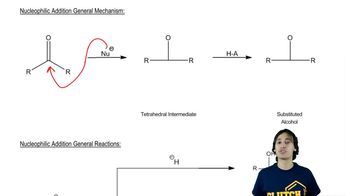
Nucleophilic addition is a fundamental reaction in organic chemistry where a nucleophile attacks an electrophilic center, typically a carbon atom in a carbonyl group. This reaction is essential for understanding how various functional groups interact, particularly in the context of carbonyl compounds reacting with nucleophiles like amines. The outcome of this reaction often leads to the formation of new functional groups.
The conditions under which a reaction occurs can significantly influence the products formed. Factors such as temperature, solvent, and the presence of catalysts can affect the rate and outcome of the reaction. In the case of imine formation, understanding the reaction environment helps predict whether the reaction will proceed to completion and the stability of the resulting imine product.