Draw and label the E and Z isomers for each of the following: c.
Verified step by step guidance
1
Step 1: Identify the double bond in the molecule. The double bond is located between the carbon atoms labeled as CHCH2 and CCH2Cl.
Step 2: Assign priorities to the substituents on each side of the double bond using the Cahn-Ingold-Prelog priority rules. For the left carbon (CHCH2), compare the ethyl group (CH2CH3) and the propyl group (CH2CH2CH3). For the right carbon (CCH2Cl), compare the chlorine atom and the isopropyl group (CH(CH3)2).
Step 3: Determine the spatial arrangement of the higher-priority groups on each side of the double bond. If the higher-priority groups are on the same side, the isomer is labeled as Z (zusammen, German for 'together'). If they are on opposite sides, the isomer is labeled as E (entgegen, German for 'opposite').
Step 4: Draw the E isomer by placing the higher-priority groups on opposite sides of the double bond. Label the structure as 'E isomer'.
Step 5: Draw the Z isomer by placing the higher-priority groups on the same side of the double bond. Label the structure as 'Z isomer'.
Verified video answer for a similar problem:
This video solution was recommended by our tutors as helpful for the problem above
Play a video:
Was this helpful?
Key Concepts
Here are the essential concepts you must grasp in order to answer the question correctly.
E/Z Isomerism
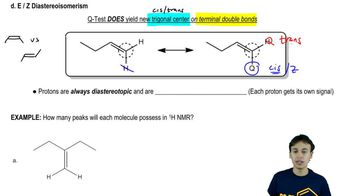
E/Z isomerism is a type of stereoisomerism that occurs in alkenes and other compounds with restricted rotation around a double bond. The 'E' (from the German 'Entgegen') designation indicates that the highest priority substituents on each carbon of the double bond are on opposite sides, while 'Z' (from 'Zusammen') indicates they are on the same side. Understanding this concept is crucial for visualizing and drawing the correct isomers.
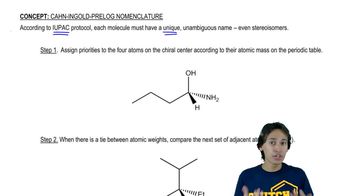
The Cahn-Ingold-Prelog priority rules are used to determine the priority of substituents attached to the double-bonded carbons in E/Z isomerism. These rules assign priority based on atomic number; the higher the atomic number of the atom directly attached to the double bond, the higher the priority. If the first atoms are the same, the priority is determined by the next atoms in the substituent chain, which is essential for correctly identifying E and Z configurations.
Drawing structural isomers involves representing the different spatial arrangements of atoms in a molecule. For E/Z isomers, it is important to accurately depict the orientation of substituents around the double bond. This requires a clear understanding of molecular geometry and the ability to visualize how different arrangements affect the overall structure, which is key to labeling the isomers correctly.