Which of the following names are correct? Correct those that are not correct. c. 4-chloro-2-pentyne d. 2,3-dimethyl-5-octyne
Verified step by step guidance
1
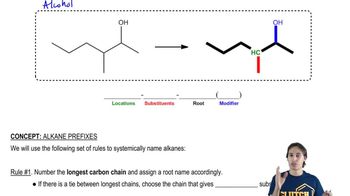
Step 1: Recall the IUPAC rules for naming alkynes. The parent chain must be the longest continuous chain containing the triple bond, and the triple bond should receive the lowest possible locant (position number). Substituents are named and numbered based on their position relative to the triple bond.
Step 2: Analyze the name '4-chloro-2-pentyne'. Identify the parent chain (pentane) and the triple bond position (2). Check if the numbering gives the lowest locant to the triple bond. If not, renumber the chain and correct the name.
Step 3: Analyze the name '2,3-dimethyl-5-octyne'. Identify the parent chain (octane) and the triple bond position (5). Check if the numbering gives the lowest locant to the triple bond. If not, renumber the chain and correct the name. Also, ensure substituents (dimethyl groups) are correctly numbered based on the new numbering.
Step 4: For both names, ensure substituents are listed in alphabetical order (if applicable) and verify that the names follow all IUPAC conventions, including proper use of hyphens and commas.
Step 5: Write the corrected names (if necessary) based on the analysis above, ensuring the triple bond and substituents are properly numbered and named according to IUPAC rules.
Verified video answer for a similar problem:
This video solution was recommended by our tutors as helpful for the problem above
Video duration:
5m
Play a video:
Was this helpful?
Key Concepts
Here are the essential concepts you must grasp in order to answer the question correctly.
IUPAC Nomenclature
IUPAC nomenclature is a systematic method for naming organic chemical compounds. It provides rules for naming based on the structure of the molecule, including the longest carbon chain, functional groups, and substituents. Understanding these rules is essential for determining whether a given name accurately reflects the structure of a compound.
Alkynes are hydrocarbons that contain at least one carbon-carbon triple bond. Their general formula is CnH2n-2, and they can be classified as terminal or internal based on the position of the triple bond. Recognizing the structure of alkynes is crucial for correctly interpreting and naming compounds like 4-chloro-2-pentyne and 2,3-dimethyl-5-octyne.
In organic nomenclature, the position of substituents on the main carbon chain is indicated by numbers. These numbers must reflect the lowest possible locants for the substituents and functional groups. Correctly identifying and numbering the positions of substituents is vital for ensuring that the compound's name accurately describes its structure.