For which of the following reactions would you expect elimination to be more favored than substitution? (e)
Verified step by step guidance
1
Step 1: Analyze the reaction conditions for each case. The first reaction uses NaSCH₃ in DMSO, which is a strong nucleophile and a polar aprotic solvent. The second reaction uses NaOEt in EtOH, which is a strong base and a polar protic solvent.
Step 2: Understand the role of the solvent. Polar aprotic solvents like DMSO favor substitution reactions (S_N2 mechanism) because they stabilize the transition state without stabilizing the nucleophile. Polar protic solvents like EtOH favor elimination reactions (E2 mechanism) because they stabilize the base and promote proton abstraction.
Step 3: Consider the nucleophile/base. NaSCH₃ is a strong nucleophile but a weak base, favoring substitution over elimination. NaOEt is both a strong nucleophile and a strong base, favoring elimination over substitution.
Step 4: Evaluate the structure of the substrate. Both substrates are secondary alkyl halides, which can undergo either substitution or elimination. However, elimination is more likely when a strong base is present, as in the second reaction.
Step 5: Conclude that elimination is more favored in the second reaction (NaOEt/EtOH) due to the combination of a strong base and polar protic solvent, which promotes the E2 mechanism.
Verified video answer for a similar problem:

This video solution was recommended by our tutors as helpful for the problem above
Video duration:
4m
Play a video:
Was this helpful?
Key Concepts
Here are the essential concepts you must grasp in order to answer the question correctly.
Elimination vs. Substitution Reactions
In organic chemistry, elimination reactions involve the removal of atoms or groups from a molecule, resulting in the formation of a double bond or a ring structure. In contrast, substitution reactions replace one atom or group with another. The preference for elimination over substitution often depends on factors such as the structure of the substrate, the nature of the leaving group, and the reaction conditions.
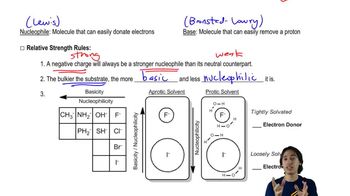
The choice of solvent can significantly influence the outcome of a reaction. Polar aprotic solvents, like DMSO, favor elimination reactions by stabilizing the transition state and promoting the formation of alkenes. Conversely, polar protic solvents, such as ethanol, tend to stabilize carbocations, which can lead to substitution reactions. Understanding solvent effects is crucial for predicting reaction pathways.
Nucleophilicity refers to the ability of a species to donate an electron pair to form a bond, while basicity measures the tendency of a species to accept protons. Strong bases are typically better nucleophiles and favor elimination reactions, especially in the presence of a good leaving group. In the given reactions, the nucleophiles (NaSCH3 and NaOEt) differ in their basicity, influencing whether elimination or substitution is favored.