Identify whether each of the following reactions proceed by an SN1, SN2, E1, or E2 mechanism. (c)
Verified step by step guidance
1
Analyze the substrate: The substrate is a benzylic sulfonate ester, which is a good leaving group. The benzylic position is stabilized by resonance, making it favorable for substitution reactions.
Examine the nucleophile: KCN (potassium cyanide) is a strong nucleophile. Strong nucleophiles typically favor SN2 mechanisms over SN1 mechanisms.
Consider the solvent: DMSO (dimethyl sulfoxide) is a polar aprotic solvent. Polar aprotic solvents stabilize the transition state of SN2 reactions and do not stabilize carbocations, making SN2 more likely than SN1.
Evaluate steric hindrance: The benzylic position is relatively unhindered, which is ideal for an SN2 reaction since SN2 requires a backside attack by the nucleophile.
Rule out elimination mechanisms: There is no strong base present, and the reaction conditions (strong nucleophile and polar aprotic solvent) are more suited for substitution rather than elimination. Therefore, E1 and E2 mechanisms are unlikely.
Verified video answer for a similar problem:
This video solution was recommended by our tutors as helpful for the problem above
Play a video:
Was this helpful?
Key Concepts
Here are the essential concepts you must grasp in order to answer the question correctly.
Nucleophilic Substitution Mechanisms
Nucleophilic substitution reactions can occur via two primary mechanisms: S_N1 and S_N2. S_N1 reactions involve a two-step process where the leaving group departs first, forming a carbocation intermediate, followed by nucleophilic attack. In contrast, S_N2 reactions are single-step processes where the nucleophile attacks the substrate simultaneously as the leaving group departs, leading to a concerted mechanism.
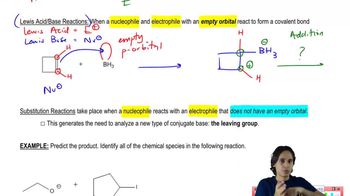
Nucleophiles and Electrophiles can react in Substitution Reactions.
Elimination Reactions
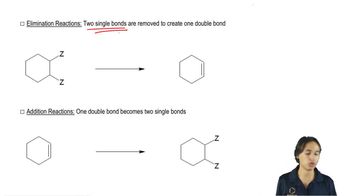
Elimination reactions can also occur through two mechanisms: E1 and E2. E1 reactions involve the formation of a carbocation intermediate after the leaving group departs, followed by deprotonation to form a double bond. E2 reactions are concerted, where the base abstracts a proton while the leaving group departs, resulting in the formation of a double bond in a single step.
The choice between S_N1, S_N2, E1, and E2 mechanisms depends on several factors, including the structure of the substrate (primary, secondary, or tertiary), the strength and concentration of the nucleophile or base, and the solvent used. Polar protic solvents favor S_N1 and E1 mechanisms by stabilizing carbocations, while polar aprotic solvents favor S_N2 and E2 mechanisms by enhancing nucleophilicity.