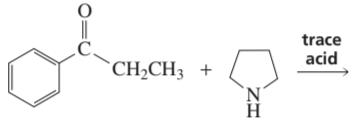
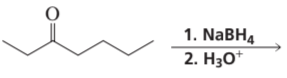
What are the products of the following reactions? Show all stereoisomers that are formed. c. d.
Verified step by step guidance
1
Step 1: Analyze the reactants and reagents. The starting material is a ketone (2-pentanone) with a methyl group and an ethyl group attached to the carbonyl carbon. The reagent is dimethylamine (CH3)2NH in the presence of HCl.
Step 2: Recognize the type of reaction. This is an imine formation reaction, where the ketone reacts with a primary or secondary amine under acidic conditions to form an imine (Schiff base).
Step 3: Understand the mechanism. The reaction proceeds through nucleophilic attack of the amine on the carbonyl carbon, followed by proton transfers and dehydration to form the imine. The lone pair on the nitrogen of dimethylamine attacks the electrophilic carbonyl carbon, forming a tetrahedral intermediate.
Step 4: Consider stereoisomer formation. Since the starting ketone is achiral and the reaction does not introduce any new stereocenters, no stereoisomers are formed in this case. The product will be a single imine structure.
Step 5: Write the product structure. The imine product will have the nitrogen double-bonded to the carbon that was originally part of the carbonyl group, with the dimethyl groups attached to the nitrogen. The ethyl and methyl groups remain attached to the carbonyl carbon.
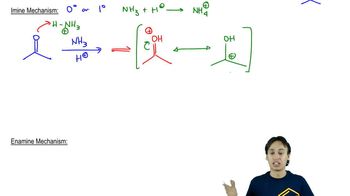
Verified video answer for a similar problem:
This video solution was recommended by our tutors as helpful for the problem above
Video duration:
9m
Play a video:
Was this helpful?
Key Concepts
Here are the essential concepts you must grasp in order to answer the question correctly.
Imine Formation
Imine formation is a reaction between an aldehyde or ketone and a primary amine, resulting in the creation of an imine. This process typically involves the nucleophilic attack of the amine on the carbonyl carbon, followed by the elimination of water. The reaction is often catalyzed by acids, such as HCl, which protonate the carbonyl oxygen, enhancing the electrophilicity of the carbonyl carbon.
Stereoisomerism refers to the phenomenon where compounds have the same molecular formula and connectivity of atoms but differ in the spatial arrangement of their atoms. In the context of imine formation, stereoisomers can arise due to the presence of chiral centers in the reactants or products, leading to different configurations (e.g., E/Z or R/S isomers) that must be represented when showing all possible products.
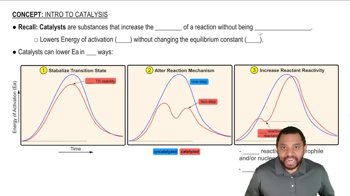
Catalysis involves the acceleration of a chemical reaction by a substance called a catalyst, which is not consumed in the reaction. In the formation of imines, HCl acts as a catalyst by facilitating the protonation of the carbonyl oxygen, making the carbonyl carbon more susceptible to nucleophilic attack by the amine. Understanding the role of catalysts is crucial for predicting reaction pathways and product distributions.