For each molecular formula, draw all the possible constitutional isomers of alcohols with that formula. Give the IUPAC name for each alcohol. (c) C3H6O
Verified step by step guidance
1
Step 1: Understand the problem. Constitutional isomers are compounds with the same molecular formula but different connectivity of atoms. For alcohols, the functional group is -OH (hydroxyl group). We need to identify all possible structures for each molecular formula where the -OH group is attached to different carbon atoms, ensuring unique connectivity.
Step 2: For (a) C3H8O, start by arranging the three carbon atoms in a straight chain (propane). Place the -OH group on different carbons (primary, secondary positions). Then consider branching possibilities, if any, and ensure all structures are unique. Assign IUPAC names to each structure.
Step 3: For (b) C4H10O, arrange the four carbon atoms in a straight chain (butane) and place the -OH group on different carbons. Then consider branching (e.g., isobutane) and attach the -OH group to different positions. Ensure all structures are unique and assign IUPAC names to each alcohol.
Step 4: For (c) C3H6O, note that the molecular formula suggests a degree of unsaturation (double bond or ring). Consider structures where the -OH group is attached to a carbon-carbon double bond (enol) or a saturated carbon. Ensure all structures are unique and assign IUPAC names.
Step 5: For (d) C3H4O, note that the molecular formula suggests two degrees of unsaturation. Consider structures with a carbon-carbon triple bond (alkynol) or a combination of a double bond and a hydroxyl group. Ensure all structures are unique and assign IUPAC names to each alcohol.
Verified video answer for a similar problem:
This video solution was recommended by our tutors as helpful for the problem above
Video duration:
5m
Play a video:
Was this helpful?
Key Concepts
Here are the essential concepts you must grasp in order to answer the question correctly.
Constitutional Isomers
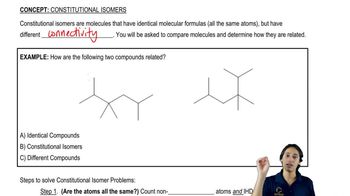
Constitutional isomers are compounds that have the same molecular formula but differ in the connectivity of their atoms. This means that the arrangement of atoms in the molecule varies, leading to different structural forms. Understanding how to draw and identify these isomers is crucial for determining the various alcohols that can be formed from a given molecular formula.
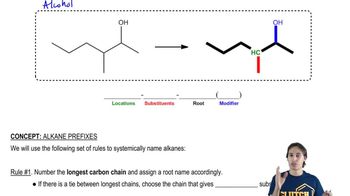
IUPAC nomenclature is a systematic method for naming organic chemical compounds. It provides a set of rules to create unique names based on the structure of the molecule, including the longest carbon chain, functional groups, and their positions. Mastery of IUPAC naming is essential for accurately identifying and communicating the identity of each alcohol isomer derived from the molecular formulas.
Functional groups are specific groups of atoms within molecules that are responsible for the characteristic chemical reactions of those molecules. In the case of alcohols, the hydroxyl group (-OH) is the functional group that defines their properties. Recognizing functional groups is vital for predicting the behavior of compounds and for distinguishing between different types of isomers.