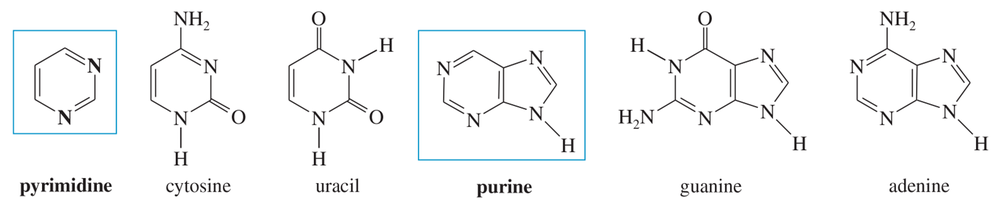
The ribonucleosides that make up ribonucleic acid (RNA) are composed of D-ribose (a sugar) and four heterocyclic “bases.” The general structure of a ribonucleoside is shown here. The four heterocyclic bases are cytosine, uracil, guanine, and adenine. Cytosine and uracil are called pyrimidine bases because their structures resemble pyrimidine. Guanine and adenine are called purine bases because their structures resemble purine. b. Predict which nitrogen atoms are basic.
Verified step by step guidance
1
Examine the structures of the pyrimidine and purine bases provided in the image. Pyrimidine bases (cytosine and uracil) have a single six-membered ring, while purine bases (guanine and adenine) have a fused bicyclic structure consisting of a six-membered ring and a five-membered ring.
Identify the nitrogen atoms in each base. Nitrogen atoms in heterocyclic rings can act as basic sites if they have a lone pair of electrons that is not involved in resonance or aromaticity.
For pyrimidine bases (cytosine and uracil), focus on the nitrogen atoms in the six-membered ring. The nitrogen atoms that are not directly bonded to hydrogen or involved in resonance stabilization are likely to be basic.
For purine bases (guanine and adenine), analyze the nitrogen atoms in both the six-membered and five-membered rings. Nitrogen atoms with lone pairs that are not delocalized into the aromatic system are potential basic sites.
Predict the basicity of each nitrogen atom based on its electronic environment. Nitrogen atoms with lone pairs that are readily available for protonation (not involved in resonance or aromatic stabilization) are considered basic.
Verified video answer for a similar problem:
This video solution was recommended by our tutors as helpful for the problem above
Video duration:
7m
Play a video:
0 Comments
Key Concepts
Here are the essential concepts you must grasp in order to answer the question correctly.
Basicity of Nitrogen Atoms
Basicity in organic chemistry refers to the ability of a compound to accept protons (H+ ions). In the context of nitrogen atoms in heterocyclic bases, basicity is influenced by the availability of a lone pair of electrons on the nitrogen atom, which can bond with protons. The nitrogen atoms in purines and pyrimidines can vary in their basicity depending on their position within the ring structure and the presence of adjacent electronegative atoms.
Heterocyclic compounds are cyclic structures that contain at least one atom that is not carbon, such as nitrogen, oxygen, or sulfur. In RNA, the heterocyclic bases (cytosine, uracil, guanine, and adenine) are crucial for the structure and function of nucleic acids. The presence of nitrogen in these bases contributes to their chemical properties, including their ability to form hydrogen bonds and participate in base pairing.
Pyrimidine and purine bases are two classes of nitrogenous bases found in nucleic acids. Pyrimidines, which include cytosine and uracil, have a single six-membered ring structure, while purines, such as guanine and adenine, consist of a fused double-ring structure. Understanding the structural differences between these bases is essential for predicting their chemical behavior, including which nitrogen atoms are likely to be basic and how they interact in RNA.


 7:09 minutes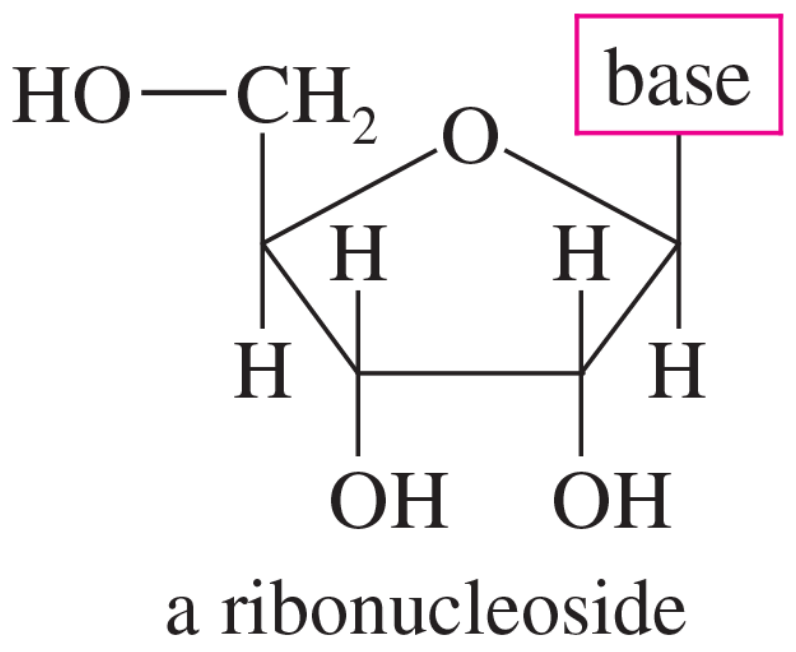
 Verified step by step guidance
 1:45
1:45