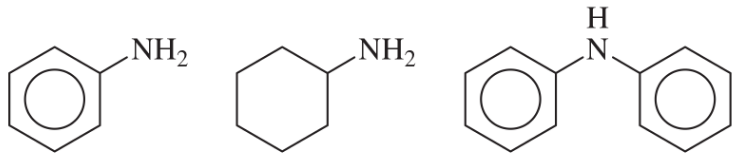
Rank the amines in each set in order of increasing basicity. (a)
Verified step by step guidance
1
Step 1: Understand the concept of basicity in amines. Basicity refers to the ability of a compound to donate a lone pair of electrons to a proton (H⁺). Amines are basic because the nitrogen atom has a lone pair of electrons that can accept a proton.
Step 2: Analyze the structures provided. The first amine is an aniline (benzene ring with an NH₂ group), the second is cyclohexylamine (cyclohexane ring with an NH₂ group), and the third is diphenylamine (two benzene rings attached to an NH group).
Step 3: Consider the electronic effects of the groups attached to the nitrogen atom. In aniline, the lone pair on nitrogen is partially delocalized into the aromatic ring, reducing its availability to accept a proton and thus decreasing basicity. In cyclohexylamine, the nitrogen's lone pair is not delocalized, making it more available for protonation and increasing basicity. In diphenylamine, the lone pair is partially delocalized into both aromatic rings, further reducing basicity compared to aniline.
Step 4: Rank the amines based on their basicity. Cyclohexylamine is the most basic because its nitrogen lone pair is fully available for protonation. Aniline is less basic due to partial delocalization of the lone pair into the aromatic ring. Diphenylamine is the least basic because the lone pair is delocalized into two aromatic rings.
Step 5: Final ranking in order of increasing basicity: Diphenylamine < Aniline < Cyclohexylamine.
Verified video answer for a similar problem:
This video solution was recommended by our tutors as helpful for the problem above
Video duration:
2m
Play a video:
Was this helpful?
Key Concepts
Here are the essential concepts you must grasp in order to answer the question correctly.
Basicity of Amines
Basicity in amines refers to their ability to accept protons (H+) from acids. This property is influenced by the availability of the lone pair of electrons on the nitrogen atom, which can bond with protons. Factors such as steric hindrance and the presence of electron-donating or withdrawing groups can significantly affect the basicity of different amines.
The inductive effect describes how the presence of electronegative atoms or groups near the nitrogen atom in an amine can influence its basicity. Electron-withdrawing groups decrease basicity by stabilizing the lone pair on nitrogen, making it less available for protonation. Conversely, electron-donating groups enhance basicity by increasing the electron density around the nitrogen, facilitating proton acceptance.
Steric hindrance refers to the spatial arrangement of atoms around the nitrogen atom in an amine, which can impede the approach of protons. Bulky substituents can create steric barriers that reduce the amine's ability to accept protons, thereby decreasing its basicity. Understanding the steric effects is crucial when ranking amines based on their basicity.