What alkyl bromide(s) should be used in the malonic ester synthesis of each of the following carboxylic acids? a. propanoic acid b. 2-methylpropanoic acid
Verified step by step guidance
1
Step 1: Understand the malonic ester synthesis. This reaction involves the alkylation of a malonic ester (diethyl malonate) followed by hydrolysis and decarboxylation to produce a carboxylic acid. The key step is the alkylation, where an alkyl halide reacts with the enolate of the malonic ester.
Step 2: For part (a), propanoic acid (CH₃CH₂COOH), identify the alkyl group that needs to be added to the malonic ester. The target carboxylic acid has a three-carbon chain, so the alkyl group to be added is ethyl (CH₃CH₂). The corresponding alkyl bromide is ethyl bromide (CH₃CH₂Br).
Step 3: For part (b), 2-methylpropanoic acid ((CH₃)₂CHCOOH), identify the alkyl group that needs to be added to the malonic ester. The target carboxylic acid has a branched chain with a methyl group at the second carbon. The alkyl group to be added is isopropyl (CH₃)₂CH. The corresponding alkyl bromide is isopropyl bromide ((CH₃)₂CHBr).
Step 4: Write the general reaction for the malonic ester synthesis. The malonic ester (CH₂(CO₂Et)₂) is deprotonated with a base (e.g., NaOEt) to form the enolate ion. This enolate ion reacts with the alkyl bromide (RBr) in an SN2 reaction to form the alkylated malonic ester.
Step 5: After alkylation, the alkylated malonic ester undergoes hydrolysis (with aqueous acid) to form a dicarboxylic acid, followed by decarboxylation (heating) to yield the desired carboxylic acid. Ensure the chosen alkyl bromide matches the structure of the target carboxylic acid.
Verified video answer for a similar problem:
This video solution was recommended by our tutors as helpful for the problem above
Video duration:
6m
Play a video:
Was this helpful?
Key Concepts
Here are the essential concepts you must grasp in order to answer the question correctly.
Malonic Ester Synthesis
Malonic ester synthesis is a method for synthesizing carboxylic acids through the alkylation of malonic ester followed by hydrolysis and decarboxylation. This reaction typically involves the use of a strong base to deprotonate the malonic ester, allowing it to act as a nucleophile and react with an alkyl halide. The choice of alkyl halide is crucial as it determines the structure of the final carboxylic acid product.
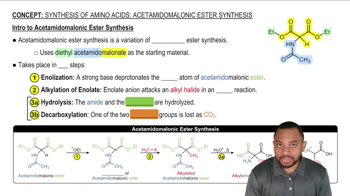
Synthesis of Amino Acids: Acetamidomalonic Ester Synthesis Concept 1
Alkyl Bromides
Alkyl bromides are organic compounds containing a bromine atom attached to an alkyl group. They are commonly used as electrophiles in nucleophilic substitution reactions, making them suitable for the malonic ester synthesis. The structure of the alkyl bromide influences the final product, so selecting the correct alkyl bromide is essential for achieving the desired carboxylic acid.
Peptide Sequencing: Partial Hydrolysis with Cyanogen Bromide Concept 1
Carboxylic Acid Structure
Carboxylic acids are organic compounds characterized by the presence of a carboxyl group (-COOH). The structure of the target carboxylic acid dictates the required alkyl bromide in the malonic ester synthesis. Understanding the relationship between the carboxylic acid's carbon chain length and branching is vital for determining the appropriate alkyl bromide to use in the synthesis process.