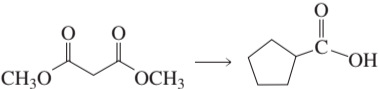
Design a synthesis for each of the following compounds using the given starting material: d.
Verified step by step guidance
1
Analyze the target compound and identify the functional groups present. Determine the transformations required to convert the starting material into the target compound.
Examine the starting material and assess its structure. Identify the functional groups and carbon skeleton to determine how it can be modified to achieve the target compound.
Plan the synthesis by selecting appropriate reactions for each transformation. Consider reagents, reaction conditions, and intermediates that will lead to the desired product.
Write out the step-by-step reaction sequence, ensuring that each step is chemically feasible and leads closer to the target compound. Include any necessary purification or isolation steps for intermediates.
Verify the synthesis by checking that the carbon skeleton and functional groups in the target compound match the final product of the proposed reaction sequence.
Verified video answer for a similar problem:
This video solution was recommended by our tutors as helpful for the problem above
Play a video:
Was this helpful?
Key Concepts
Here are the essential concepts you must grasp in order to answer the question correctly.
Organic Synthesis
Organic synthesis is the process of constructing complex organic molecules from simpler ones through a series of chemical reactions. It involves understanding reaction mechanisms, functional group transformations, and the strategic selection of reagents and conditions to achieve the desired product. Mastery of synthesis is crucial for chemists to design pathways for creating pharmaceuticals, agrochemicals, and other organic compounds.
Synthesis of Amino Acids: Strecker Synthesis Example 1
Reaction Mechanisms
A reaction mechanism describes the step-by-step sequence of elementary reactions that occur during a chemical transformation. Understanding mechanisms is essential for predicting the products of reactions and for designing synthetic routes. Key concepts include nucleophiles, electrophiles, and the role of catalysts, which help to elucidate how reactants are converted into products.
Functional groups are specific groups of atoms within molecules that are responsible for the characteristic chemical reactions of those molecules. Recognizing functional groups is vital in organic chemistry as they dictate the reactivity and properties of compounds. Common functional groups include alcohols, amines, and carboxylic acids, and understanding their behavior is essential for planning synthetic strategies.