Rank the reactivity of the following carbonyls with nucleophiles, from least reactive to most reactive.
Verified step by step guidance
1
Analyze the structures of the carbonyl compounds provided. The reactivity of carbonyls with nucleophiles depends on electronic and steric factors.
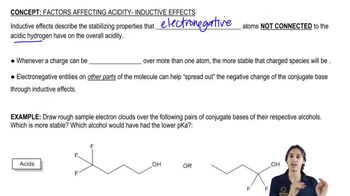
Consider the electronic effects: Electron-withdrawing groups (like fluorine) increase the partial positive charge on the carbonyl carbon, making it more electrophilic and reactive toward nucleophiles.
Evaluate steric hindrance: Bulky groups near the carbonyl carbon can hinder the approach of nucleophiles, decreasing reactivity.
Rank the compounds based on these factors: The compound with three fluorine atoms attached to the alpha carbon will be the most reactive due to strong electron-withdrawing effects. The compound with bulky alkyl groups near the carbonyl will be the least reactive due to steric hindrance.
Order the compounds from least reactive to most reactive: The compound with bulky alkyl groups is least reactive, followed by the simple ketone, and the compound with fluorine atoms is most reactive.
Verified video answer for a similar problem:
This video solution was recommended by our tutors as helpful for the problem above
Play a video:
Was this helpful?
Key Concepts
Here are the essential concepts you must grasp in order to answer the question correctly.
Carbonyl Reactivity
Carbonyl compounds, characterized by the C=O functional group, exhibit varying reactivity towards nucleophiles based on their substituents. The presence of electron-withdrawing groups, such as halogens, increases the electrophilicity of the carbonyl carbon, making it more reactive. Conversely, electron-donating groups decrease reactivity by stabilizing the carbonyl, making it less susceptible to nucleophilic attack.
The inductive effect refers to the electron-withdrawing or electron-donating influence of substituents through sigma bonds. In the context of carbonyl compounds, electronegative atoms like fluorine exert a strong inductive effect, pulling electron density away from the carbonyl carbon. This effect enhances the carbon's positive character, thereby increasing its reactivity towards nucleophiles.
Steric hindrance occurs when bulky groups around a reactive site impede the approach of nucleophiles. In carbonyl compounds, larger substituents can create steric barriers that reduce the accessibility of the carbonyl carbon. This can significantly affect the reactivity of carbonyls, as less hindered carbonyls are more likely to undergo nucleophilic attack compared to those with larger substituents.