In each case, circle the stronger nucleophile. (b)
Verified step by step guidance
1
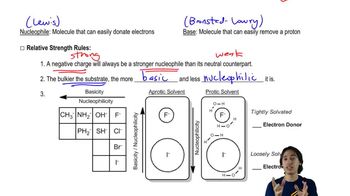
Step 1: Understand the concept of nucleophilicity. Nucleophilicity refers to the ability of a species to donate a pair of electrons to an electrophile. It is influenced by factors such as charge, electronegativity, steric hindrance, and the solvent used.
Step 2: Compare the electronegativity of the atoms involved. Oxygen (in -OH) is more electronegative than nitrogen (in -NH2), meaning oxygen holds onto its electrons more tightly, making it less likely to donate them compared to nitrogen.
Step 3: Consider the lone pair availability. Nitrogen in -NH2 has a lone pair of electrons that is less tightly held due to its lower electronegativity, making it a stronger nucleophile compared to oxygen in -OH.
Step 4: Evaluate the steric hindrance. Both -OH and -NH2 groups are similar in size and steric hindrance, so this factor does not significantly affect their nucleophilicity in this comparison.
Step 5: Conclude based on the above factors. Nitrogen in -NH2 is the stronger nucleophile compared to oxygen in -OH due to its lower electronegativity and greater ability to donate electrons.
Verified video answer for a similar problem:
This video solution was recommended by our tutors as helpful for the problem above.
Play a video:
0 Comments
Was this helpful?
Key Concepts
Here are the essential concepts you must grasp in order to answer the question correctly.
Nucleophilicity
Nucleophilicity refers to the ability of a species to donate an electron pair to an electrophile during a chemical reaction. Stronger nucleophiles are more reactive and can more readily form bonds with electrophiles. Factors influencing nucleophilicity include charge, electronegativity, and steric hindrance.
Functional groups are specific groups of atoms within molecules that are responsible for the characteristic chemical reactions of those molecules. In this case, the hydroxyl group (–OH) and the amino group (–NH2) are functional groups that influence the nucleophilicity of the compounds they are part of, with the amino group generally being a stronger nucleophile.
Basicity and nucleophilicity are related concepts, as both involve the donation of electron pairs. However, basicity refers to the ability to accept protons (H+), while nucleophilicity focuses on the ability to donate electrons to electrophiles. Generally, stronger bases are also stronger nucleophiles, but this is not always the case due to steric and solvent effects.

 Mullins 1st Edition
 Verified step by step guidance
 08:27
08:27