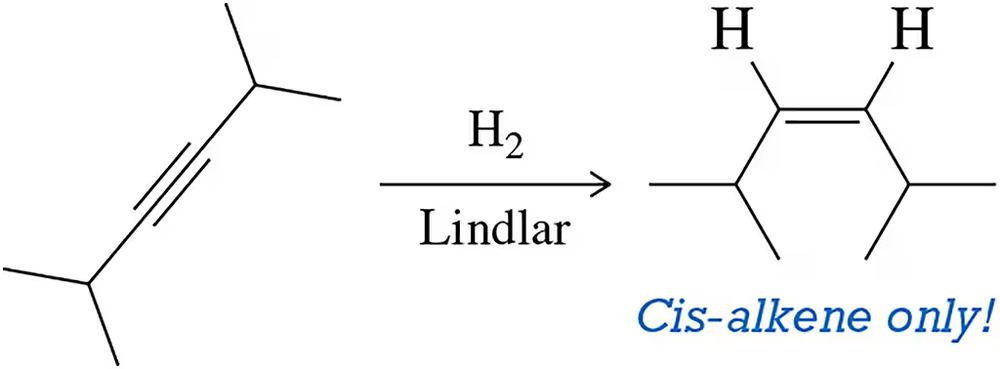
Reduction of an alkyne using the Lindlar catalyst, a reaction presented in Section 10.6.2, produces only the cis-alkene. Why?
Verified step by step guidance
1
Understand the Lindlar catalyst: The Lindlar catalyst is a palladium-based catalyst that is poisoned with lead acetate and quinoline. This poisoning reduces the activity of the catalyst, making it selective for partial hydrogenation of alkynes to alkenes without further reducing the alkene to an alkane.
Recognize the stereoselectivity: The Lindlar catalyst facilitates syn-addition of hydrogen atoms to the alkyne. Syn-addition means that both hydrogen atoms are added to the same side of the triple bond, resulting in the formation of a cis-alkene.
Consider the mechanism: The alkyne adsorbs onto the surface of the Lindlar catalyst, where hydrogen gas is activated. The hydrogen atoms are delivered to the alkyne in a controlled manner, ensuring that the addition occurs on the same face of the molecule.
Understand why trans-alkenes are not formed: The poisoned catalyst prevents over-reduction and does not allow the alkyne to rotate freely during the reaction. This restriction ensures that the hydrogen atoms are added in a syn fashion, preventing the formation of trans-alkenes.
Relate to the reaction conditions: The mild conditions of the Lindlar catalyst reaction are specifically designed to stop at the cis-alkene stage, making it an ideal method for selectively producing cis-alkenes from alkynes.
Verified video answer for a similar problem:
This video solution was recommended by our tutors as helpful for the problem above
Video duration:
3m
Play a video:
Was this helpful?
Key Concepts
Here are the essential concepts you must grasp in order to answer the question correctly.
Lindlar Catalyst
The Lindlar catalyst is a palladium-based catalyst that is partially poisoned with lead salts. This modification allows it to selectively hydrogenate alkynes to cis-alkenes without further reducing them to alkanes. The controlled reactivity of the Lindlar catalyst is crucial for achieving the desired stereochemistry in the reduction process.
Stereochemistry refers to the spatial arrangement of atoms in molecules and how this affects their chemical properties. In the case of alkenes, the cis and trans configurations arise from the restricted rotation around the double bond. The use of the Lindlar catalyst specifically leads to the formation of the cis-alkene due to the catalyst's ability to stabilize the transition state that favors this configuration.
Selective hydrogenation is a chemical process that adds hydrogen to unsaturated compounds, such as alkynes, while controlling the extent of the reaction. In the context of the Lindlar catalyst, this process is designed to stop at the alkene stage, preventing complete reduction to alkanes. This selectivity is essential for producing specific products with desired properties, such as the cis-alkene in this reaction.